

Learn how and why veterinary bills are increasing, and how a Healthy Paws plan can help.


Three rescues across North Carolina and Georgia received donations that made a big impact.

Make their food irresistible with the freshest nutritionally-balanced ingredients.
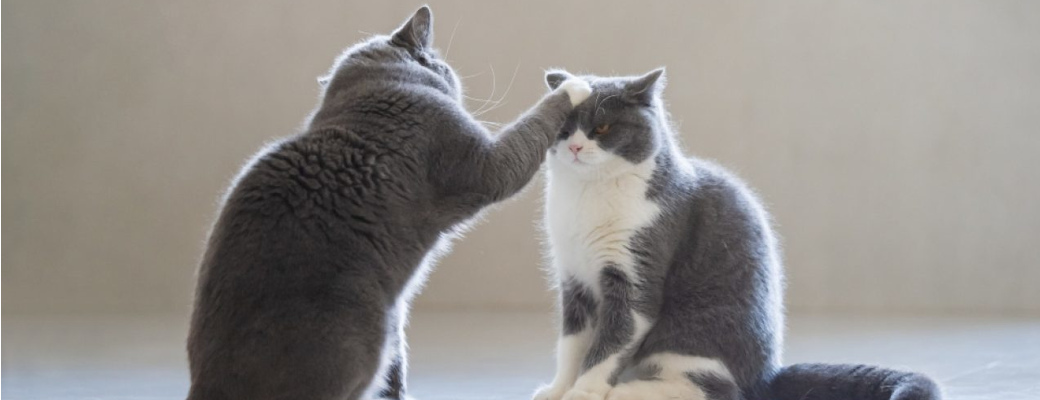
Table of Contents
Multi-cat households can be tricky to manage. For some cat parents, all of their cats get along beautifully well. For other cat parents, their cats may be at constant war with each other, with more than the occasional hissing, growling, and flailing of paws.
Cats who don’t get along can make for an unpleasant home environment for everybody. If your cats are more enemies than friends, it’s important to figure out why and come up with a plan to help them at least call a truce.
Reasons Why Cats Don’t Get Along
There are many possible reasons why your cats are not getting along. Here are a few common reasons:
Improper socialization: Socialization is the process by which a kitten learns how to properly interact with its environment, including people and other animals. Kitten socialization is crucial between about 2 and 7 weeks of age and should continue for the next few months. Not being socialized at all, or being inadequately socialized, means a kitten won’t have the skills to properly interact with other cats, setting the stage for unfriendly inter-cat behavior in a multi-cat household.
Lack of resources: Each cat in a home needs its own set of resources (space, food, water). When resources are lacking, cats will fight each other for whatever resources are available.
Aggression: Aggression is a significant source of animosity between cats. Different types of aggression may be happening between your cats:
- Territorial, such as a new cat in the home
- Inter-male, especially if the males are intact
- Defensive, to protect from a threat
- Redirected, when another cat becomes an unwitting target of pent-up aggression
Medical issues: Cats who are ill or in pain don’t make good company. If one of your cats isn’t feeling well for whatever reason, they may lash out at your other cats.
Favoritism: Do you pay more attention to one cat than the others? If so, those other cats will pick up on your favoritism and take it out on the ‘chosen’ cat.
Cats are not always obvious about what’s bothering them, so it may not be easy for you to determine precisely why your cats aren’t getting along. Consider scheduling an appointment with your veterinarian to discuss the behavioral issues between your cats. By describing your home environment and when you notice your cats not getting along, your veterinarian can help you identify the problem and devise a plan for establishing (or re-establishing) peace between your cats.
Tell us about your pet - get a quick quote
Helping Your Cats Get Along
The strategies listed below can help your cats be nicer to each other:
- Provide more resources. Give each cat its own food bowl, water bowl, and litter box. Ideally, have one litter box for each cat plus one extra. Position these items far enough apart—about 6 feet—to avoid competition between the cats.
- Give your cats more vertical space. Cats need space to climb. Purchase additional cat trees or window perches so all of your cats can climb and have their own private space. Cubby holes within cat trees can provide cozy hiding places.
- Avoid showing favoritism. Show equal attention to all of your cats, particularly during playtime. Play an interactive game with each cat individually, or as a group.
- Neuter your male cats. Intact males can be very aggressive toward each other. Neutering intact males will ratchet down the testosterone levels and the risk of inter-male aggression.
- Use pheromones. Pheromones are natural chemicals that animals (and humans) secrete in social situations. Consider using a cat pheromone, such as Feliway®, to reduce the tension between your cats.
- Reward your cats when they get along. When your cats are playing nice with each other, reward them all with treats or petting. The positive reinforcement will encourage your cats to repeat this good behavior.
- Stop the fighting. If your cats are fighting, place a sizeable impenetrable barrier, such as a cardboard box, between them. When the fighting stops, keep the cats separated until they’ve calmed down. Do not ever let your cats “fight it out”—this will only make things worse.
If you’re not having much luck with these strategies, seek professional behavioral help from a veterinary behaviorist or certified applied animal behaviorist. Bear in mind, though, that some cats may never get along; for other cats, their relationship may be beyond repair. In these situations, it is advisable to either keep the cats permanently separated in the home or rehome one of the cats.

Meet Our Writer
JoAnna Pendergrass, DVM
JoAnna Pendergrass, DVM, is a veterinarian and freelance medical writer in Atlanta, GA. After graduating from the Virginia-Maryland College of Veterinary Medicine with her veterinary degree, JoAnna completed a 2-year research fellowship in neuroscience at Emory University. During this fellowship, she learned that she could make a career out of combining her loves of science and writing. As a medical writer, JoAnna is passionate about providing pet parents at Healthy Paws with clear, concise, and engaging information about pet care. Through her writing, she strives not only to educate pet parents, but also empower them to make good health decisions for their pets. JoAnna is a member of the American Medical Writers Association.