

Learn how and why veterinary bills are increasing, and how a Healthy Paws plan can help.

Read stories of how Healthy Paws has protected pets like family and made peace of mind and more happy, healthy moments possible.

Rescue organizations across the U.S. received support for adoption efforts and ongoing care for vulnerable pets.

Make their food irresistible with the freshest nutritionally-balanced ingredients.

The Healthy Paws Community is a vibrant, social-first space for all pet lovers—whether you’re a Healthy Paws policyholder or simply passionate about pets. As a Pack Member, you can share your favorite pet photos and videos, connect with fellow pet parents, and stay informed with the latest Healthy Paws news and tips. It’s a welcoming place focused on connection, positivity, and celebrating the joy pets bring to our lives!

Everyday expenses for a pet now exceed $4,000 a year on average, according to new research. As prices continue to climb, pet owners face tough choices. Pet insurance can be a financial backstop against the unexpected.
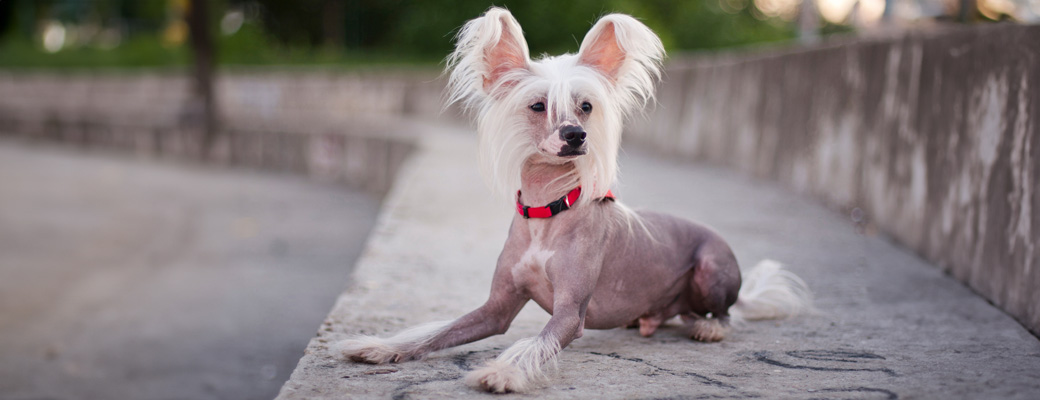
Introduction to Chinese Cresteds
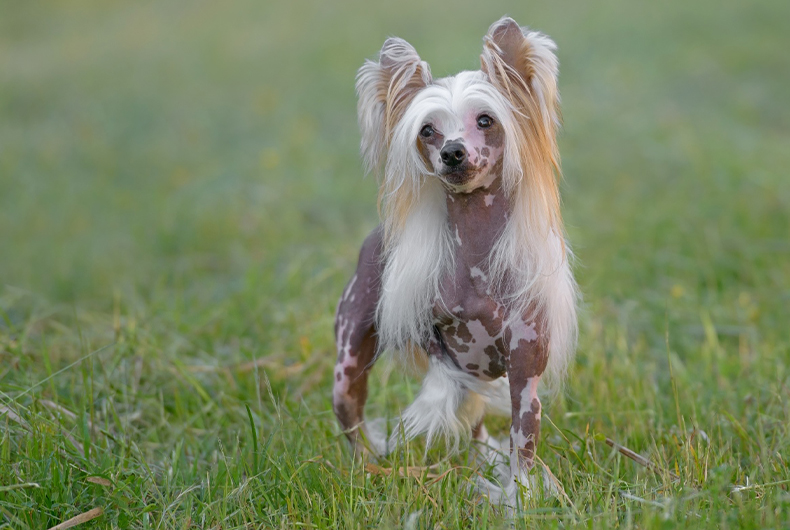
The Chinese crested is a Toy Group dog breed known for being lively and affectionate. These dogs have a unique appearance that features a spiky hairstyle, furry feet, and feathered tails. There are Chinese cresteds with smooth and soft skin considered “hairless,” and coated Chinese cresteds called “powderpuffs” with soft and silky coats.
People love these dogs because they are wonderfully devoted to their humans while also being graceful and playful. If you’re looking for a tiny housemate who doesn’t really shed or smell but easily fits right in with your family, read on to learn more about the Chinese crested breed in this Healthy Paws breed guide.
Get a pet insurance quote for your Chinese Crested today
Size of Chinese Cresteds
One of the most notable things about the Chinese crested is its size. These small dogs typically weigh between eight and 12 pounds when fully grown and stand between 11 and 13 inches tall. They generally are fully grown by the age of nine months, but some of them are done growing already by six months.
Here’s a chart detailing how big you can expect your Chinese crested to get as the dog grows from puppyhood to adulthood. Female weights are at the low end of the range, while male weights are at the high end.
| Weight Chart | 3 months | 6 months | 8 months | 12 months |
Male and female Chinese cresteds |
3 – 5 lbs. | 5 – 8 lbs. | 6 – 9 lbs. | 8 – 12 lbs. |
Characteristics of Chinese Cresteds
Chinese cresteds are sometimes referred to as “couch potato companions” because they are very content sitting and laying with you as you lounge around the house. However, these dogs are not lazy by nature and are actually very athletic, often excelling in agility competitions.
Other personality characteristics of a Chinese crested include being very loyal to one person, being great around children, and being entertaining and amusing. They like to be outside, climb and dig holes, and become easily attached to the people they are around most.
As you get to know a Chinese crested’s personality, here’s what you can expect based on their breed characteristics:
| Breed Characteristic | Level (High, Medium, Low) |
| Affectionate with People | High |
| Good with Kids | Medium |
| Good with Pets | Medium |
| Need for Exercise | Low |
| Energy Level | Low |
| Intelligence Level | Medium |
| Able to Be Trained | Medium |
| Amount of Barking | Medium |
| Amount of Shedding | Low |
History of Chinese Cresteds
It might surprise you to learn that the origin of the Chinese crested is probably not actually China. Historical records indicate that hairless dogs from Africa were brought to China during ancient times and gradually reduced in size to become miniature versions of their larger ancestors. Chinese cresteds were used to catch rats that posed disease threats on ships in China and traded among sailors around the world. They were even called Chinese ship dogs for this reason.
Chinese crested dogs were brought to ports in various places, such as Egypt and Turkey, and reported in many port towns throughout Central and South America, too. Ida Garrett, a journalist, and Debra Woods, a breeder, brought the dog to the U.S. by promoting a breeding program and studbooks. The breed began appearing in American dog shows in the late 1800s. The American Chinese Crested Club was formed in 1979, and the American Kennel Club recognized the breed in 1991.
Chinese Crested Standard Information
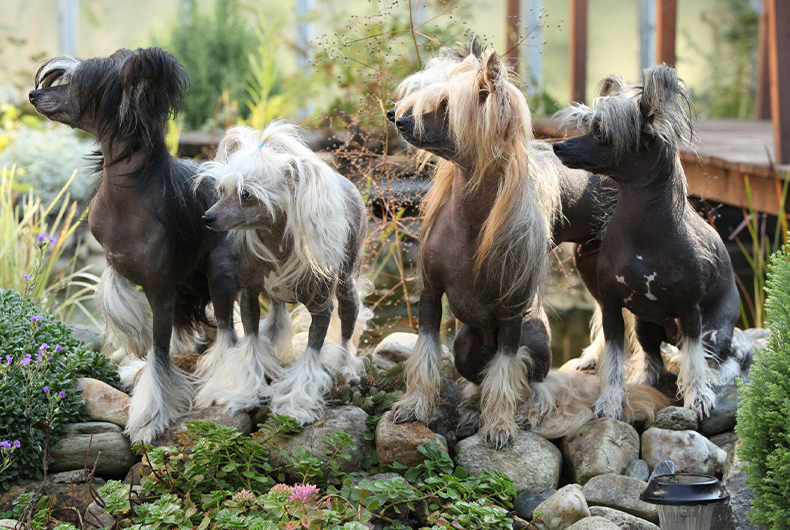
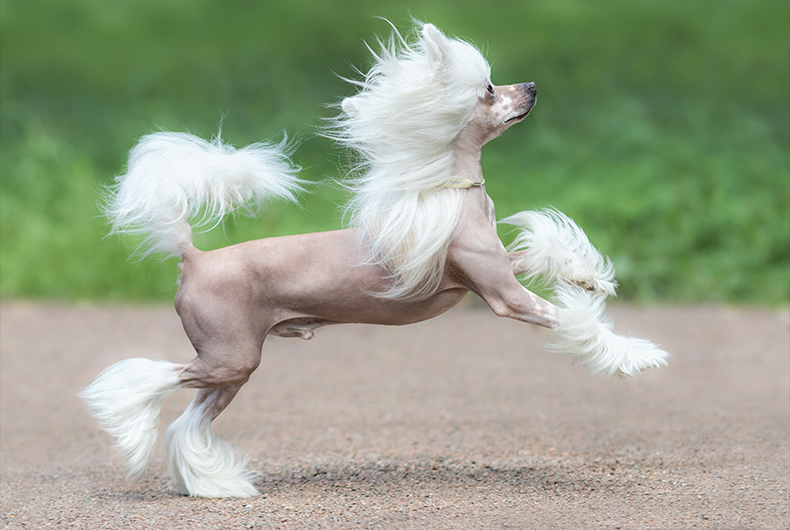
Small, fine-boned, and elegant, the Chinese crested comes in two distinct varieties, both of which are born in the same litter. Powderpuffs are completely covered in hair, while the hairless versions only have hair on the head, feet, and tail. Yet, there are many additional physical characteristics that also distinguish this type of dog.
Here is an overview of the breed standard information for Chinese cresteds:
Head:
- Alert and intense expression
- Almond-shaped eyes set wide apart
- Uncropped ears that are large and erect
- Cheeks taper into the muzzle cleanly
- Nose color varies based on the dog’s color
- Scissors or level bite
Neck, Topline, Body:
- Lean and clean neck that is slightly arched
- Level topline or slightly sloping croup
- Breastbone is not prominent
- Slender tail that tapers to a curve
- 2/3 of the tail is covered by hair in the hairless variety
Forequarters:
- Elbows close to the body
- Long, slender, and straight legs
- Dewclaws may be removed
- Nails trimmed to moderate length
Hindquarters:
- Stifle is moderately angulated
- Dewclaws may be removed
- Feet are the same as forequarters
Coat:
- The head of the hairless dogs is called a crest
- Texture of hair is soft and silky
- Skin is soft and smooth where hairless
- Coat is straight and of moderate length and density
Color:
- Any color or combination of colors is acceptable
Gait:
- Agile, lively, and smooth movement
- Trot comes and goes and moves in a straight line
Caring for Chinese Cresteds
These sensitive dogs are ideal for apartment living and being in families with children who know how to be careful and treat them well. They don’t require as much exercise or activity as many other dog breeds, and they are generally easy to groom and care for.
Here are some general tips for taking the best care of a Chinese crested:
Best Living Environments:
- Indoor environments
- No yard necessary
- Good for apartment life
- Put in a sweater during cold weather
Type of Exercise:
- Daily walks
- Running around the house
- Playtime in a small yard
Mental Enrichment:
- Agility training
- Playtime with family members
Training Strategies:
- Relatively easy to train
- Intelligent dogs that can learn various commands
- Potential for mouthiness
Grooming Tips:
- Need regular bathing and moisturizing
- Brush regularly to prevent tangles and mats in powderpuff cresteds
Common Health Problems of Chinese Cresteds
The Chinese crested is a breed with longevity and one that commonly lives for 13 to 18 years. If you purchase a Chinese crested from a responsible breeder, you can feel confident that the dog has been checked for inherited eye issues, including glaucoma, primary lens luxation, and progressive retinal atrophy. Another issue that affects this breed is patellar luxation, also known as slipped stifles. Legg-Calve Perthes disease is also common with Chinese cresteds.
In addition to these issues, these are some other of the most common health concerns that arise with Chinese cresteds:
- Dental problems, especially with hairless dogs
- Keratoconjunctivitis sicca (dry eye and inflammation disorder)
- Sunburn for hairless dogs
- Skin irritations
- Environmental allergies
- Epilepsy
Diet and Nutrition for Chinese Cresteds
An adult Chinese crested needs between ¼ cup and one cup of dry dog food per day. Some of these dogs are picky eaters and have a more refined palate than other dogs. Some Chinese crested pet parents feed their dogs fresh foods such as lean meat, fish, eggs, spinach, carrots, and blueberries. Some adult dry dog food recommendations are Blue Buffalo Chicken & Brown Rice Toy Breed Adult Dog Food and Royal Canin Size Health Nutrition X-Small Adult Dog Food.
Where to Adopt or Purchase Chinese Cresteds
One starting point to research if you want to bring a Chinese crested into your life is the American Chinese Crested Club, which offers an online breeder directory and other information about the breed. You can also adopt a Chinese crested needing a home through various rescue organizations, including Gentle Giants Rescue and Adoptions, Bare Paws Rescue, Tender Loving Crested Rescue, and Rocky Mountain Chinese Cresteds.
Pet Insurance for Chinese Cresteds
To protect your tiny pup and feel confident that you can always pay for the veterinary care needed, we highly recommend pet insurance for Chinese cresteds. These dogs have tiny bones that could be broken in an accident around the house, or they could develop a genetic condition that is common with the breed as they get older.
Healthy Paws has been the top-rated pet insurance plan for the past seven years and is trusted by over 625,000 pet parents. With a Healthy Paws plan, you can give your Chinese crested the medical attention they need because it covers new accidents, illnesses, cancer, emergency care, breed-specific conditions, genetic and hereditary conditions, and alternative care.
Get your Chinese crested health insurance quote on our website today for peace of mind and to plan for whatever may come your pup’s way.

Meet Our Writer
Stacy Painter
Stacy has always been an animal lover and has worked in the pet industry and pet insurance specifically for over a decade. As a writer since early childhood, content writing for Healthy Paws pet insurance was a natural career path to combine her two passions. She currently lives in Florida with her boyfriend and Taiwanese rescue dog, Kaya.