

Learn how and why veterinary bills are increasing, and how a Healthy Paws plan can help.


Three rescues across North Carolina and Georgia received donations that made a big impact.

Make their food irresistible with the freshest nutritionally-balanced ingredients.
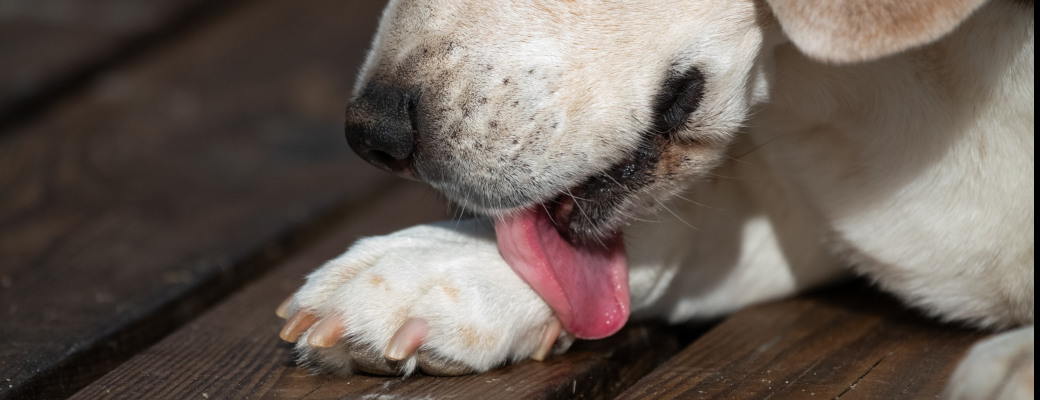
Every dog licks from time to time. Licking is soothing for dogs, both physically and emotionally. It can be their way to relieve itching, lessen pain, and alleviate boredom.
But excessive licking may also be a sign of a potentially serious health condition, and it can lead to skin damage and infections. In this article, we’ll investigate why dogs might lick excessively and what to do about it.
Causes of Excessive Licking in Dogs
There are many reasons why dogs lick excessively. Some causes can be managed at home, but others require veterinary attention.
- Itchiness – Anything that itches can lead to excessive licking. The licking may be restricted to one part of the body or cover wider areas. Common causes of dog itching include parasites like fleas and mange mites; bacterial, yeast, and fungal infections; and allergies to environmental triggers (pollen, mold, and house mites, for example) or food.
- Pain – Dogs often lick in response to pain. Repetitive licking releases endorphins, which are the body’s natural painkillers. Osteoarthritis, cuts, punctures, broken or overgrown toenails, insect bites or stings, joint injuries, cancer, and other sources of pain could be to blame.
- Nausea – Gastrointestinal problems and other conditions that cause nausea can make dogs drool, lick their lips, and lick themselves or objects in the environment like the floor or couch.
- Mental health – Repeated behaviors like constant licking release feel-good endorphins. Dogs with obsessive-compulsive disorders or anxiety or who are stressed due to boredom or changes in their lives can lick excessively to make themselves feel better.
Tell us about your pet - get a quick quote
How to Stop Excessive Licking in Dogs
Identifying the reason for a dog’s excessive licking is the first step to stopping it. Using an E-collar, bad-tasting spray, or bandages to prevent licking may help in the short term but does nothing to alleviate your dog’s discomfort. Unless the cause is obvious and easily treated at home (a small cut, for example), it’s best to make an appointment with your veterinarian.
The doctor will start by asking questions about your dog’s lifestyle, health history, and symptoms. They will also perform a complete physical exam. At this point, the vet will likely have an idea as to the likely origin of your dog’s excessive licking.
Itching
Itching is the most common cause of excessive licking in dogs. Your veterinarian may be able to identify the problem with just a physical examination (a flea infestation, for example), or they could need to run diagnostic tests such as a skin scraping to look for mange mites, skin cytology to identify bacterial and yeast infections, or a fungal culture for ringworm. Allergy testing may be necessary to identify a dog’s allergic triggers.
Once the cause of a dog’s itchiness is diagnosed and treated the excessive licking should resolve. Sometimes medications to ease itching are also necessary.
Pain
Pain is another common cause of excessive licking in dogs. Usually, the dog’s licking will focus on the painful area, such as an especially arthritic joint. Your veterinarian will need to perform a physical examination and possibly take X-rays or run other diagnostic tests to determine the source of your dog’s pain.
Whenever possible, treatment for excessive licking due to pain should try to eliminate the source of a dog’s pain, but veterinarians often also prescribe medications to improve a dog’s comfort level. Never give your dog a pain reliever without first speaking to your vet.
Nausea
Excessive licking due to nausea usually accompanies other symptoms like vomiting, a poor appetite, or weight loss. See a veterinarian if your dog’s nausea is severe or lasts more than a day or two. The doctor may need the results of bloodwork, a urinalysis, abdominal x-rays or ultrasound, and other diagnostic tests to determine why your dog is nauseous.
Treatment should be aimed at the underlying cause of a dog’s nausea, but anti-nausea medications can be beneficial while other treatments take effect. Once a dog’s nausea improves the dog’s excessive licking should resolve too.
Mental Health
Stress, anxiety, and behavioral problems can all lead to excessive licking in dogs. Boredom is a major stressor for dogs. If you think your dog is licking due to boredom, increase the amount of attention, playtime, and exercise they get throughout the day. Food puzzles are a great way to ease boredom when dogs have to be alone.
If something has recently changed in your dog’s life and they seem stressed by their new situation, try to duplicate their previous schedule to the greatest extent possible. For example, adding a new puppy to a household is often stressful for older dogs. Make sure your older dog gets plenty of one-on-one time with you and can easily escape unwanted attention from their new family member.
Over-the-counter anti-anxiety treatments like calming nutritional supplements and pheromone sprays or collars may help in mild cases of stress and anxiety. Veterinarians can prescribe medications and recommend other forms of treatment for serious mental health disorders, including severe anxiety and obsessive-compulsive disorders.
When to See the Vet Because a Dog Is Licking Excessively
Don’t panic if you notice a mild increase in your dog’s licking. If they seem healthy in all other ways, trying some safe at-home treatments may be all that is needed. Improved parasite control, omega-3 fatty acid supplements, itch-relieving dog shampoos, or calming nutritional supplements and pheromones may provide some relief.
On the other hand, dogs should be seen by a veterinarian if they are licking enough to lose hair or develop skin wounds or if they have other signs of a physical illness or behavioral problem.

Meet Our Writer
Jennifer Coates, DVM
Dr. Jennifer Coates received her Bachelor of Science degree in biology from McGill University in Montreal, Quebec, Canada. After graduation, she worked for several years in the fields of conservation and animal welfare before pursuing her childhood dream—becoming a veterinarian. She graduated with honors from the Virginia-Maryland Regional College of Veterinary Medicine and has worked as an Associate Veterinarian and Chief of Staff in Virginia, Wyoming, and Colorado. Jennifer is also a prolific writer about all things related to veterinary medicine and the well-being of our animal friends. She has published several short stories and books, including the Dictionary of Veterinary Terms, Vet-Speak Deciphered for the Non-Veterinarian. She currently contributes to the Healthy Paws pet insurance blog as a freelance writer. In her free time, Jennifer enjoys life in Colorado with her family and friends… many of whom walk on four legs.