

Learn how and why veterinary bills are increasing, and how a Healthy Paws plan can help.


Three rescues across North Carolina and Georgia received donations that made a big impact.

Make their food irresistible with the freshest nutritionally-balanced ingredients.
Key Takeaways
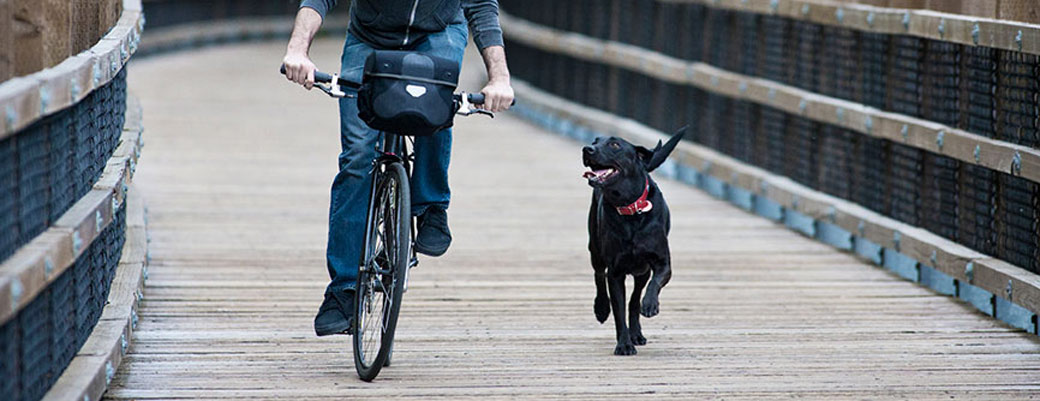
- If you have a very high-energy dog, it may be appealing to ride your bike and have your dog run beside you.
- In most cases, cycling with a dog on a leash is not recommended for safety reasons.
- If you have a safe place to ride, your dog is very athletic and well-trained and you have the right gear, you can teach your dog to run alongside you.
- If you don’t fit the criteria to have your dog run alongside, consider a trailer or basket to haul your dog.
If you have a very high-energy dog, or you cannot walk far, you may have considered riding your bike and having your dog run beside you. First, think about whether this is even a wise idea for you and your dog. In most situations, veterinarians and dog trainers do not recommend this practice, as it can be dangerous for you and the dog.
“There are not a lot of scenarios where this is going to be safe for you and the dog,” said Danette Johnston, owner of Dogs Day Out in Seattle and a consulting trainer to Healthy Paws Pet Insurance. “Just staying up on a bicycle can be challenging, much less when you have a dog pulling you in one direction or another. I also worry about dogs running too hard and injuring themselves or their paws getting torn up on the pavement.”
Here are some considerations
- Do you live somewhere with roads that have little to no traffic and few pedestrians or other bicyclists around?
- Is your dog young and fit enough to run at a fast pace without risking overheating or injury? Some dogs, including short-nosed breeds or dogs who are overweight or have health issues, are not built for running. And puppies, whose bones have not fully formed, or senior dogs should not participate in this activity. Check with your vet if you are not sure.
- Is your dog supremely well trained and obedient, so they won’t run after a squirrel or another dog, pulling you down with them? They should know commands such as come, watch me, leave it, slow and stop.
- Are you a confident enough rider that you won’t fall if your dog pulls to one side or backward?
- Is the weather cool enough that your dog’s paws will not get burned on the pavement?
- Do you have the right equipment to ride safely with your dog?
If you are the rare person who can say “yes” to all these questions, then riding a bike with your dog is an option.
One way to ride a bike with your dog that avoids some hazards is to ride off-road or mountain bike trails with your dog off-leash. However, this can still pose problems as other mountain bikers may have to swerve or stop to avoid your dog or be upset to see them out on busy trails. And you’ll still want to be sure your dog can handle the rigors of running fast and not overheat.
With all those caveats, riding with your dog is an excellent exercise for the right dog and can be a bonding experience for you.
Europeans have even created a new sport they call “bikejoring,” a knock-off of skijoring, based on riding with dogs competitively on mountain bikes. The difference is that dogs pull the riders for more speed on a designated course. The sport is best for dog breeds that love to run and are already known for pulling, such as sled dogs.
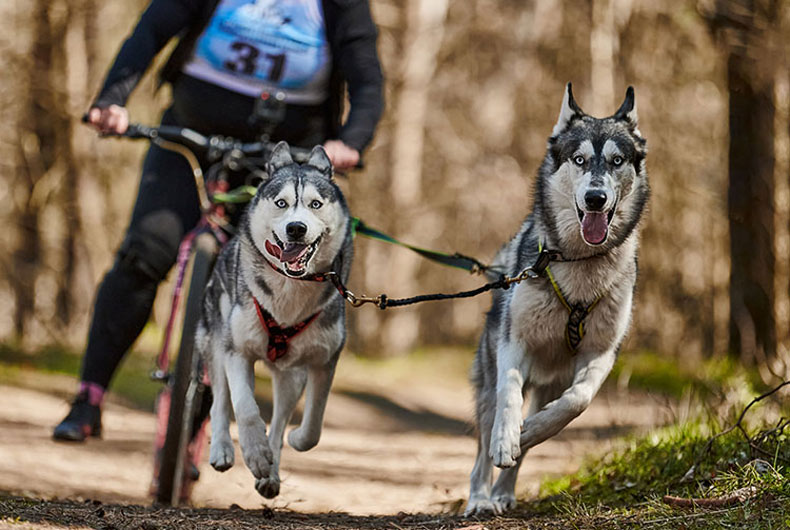
Here are some tips on how to train your dog to run next to a bike:
1. Start slowly
Begin by walking your bike and dog together. This will help your dog get used to being near the bike before you start moving with more speed. Move up to walking with your bike between your legs, then coast slowly.
2. Practice commands
Teach your dog basic commands like “heel” and “stay” to help keep them focused on you and the bike. Reward them with treats or praise when they follow your commands successfully.
3. Gradually increase speed and distance
Start pedaling slowly once your dog is comfortable walking next to the bike. Increase speed gradually and only if your dog keeps up without any issues. Keep rides to 10-15 minutes for the first few weeks and slowly add time.
4. Be consistent
Practice regularly to help your dog get used to running next to the bike. Over time, they will become more comfortable and confident.
5. Stay attuned to your dog
Be safety conscious and pay attention to how your dog is feeling. If your dog is panting excessively, slowing down, or seems anxious, stop immediately and walk home. Be sure to carry water for your pup and encourage them to drink frequently.
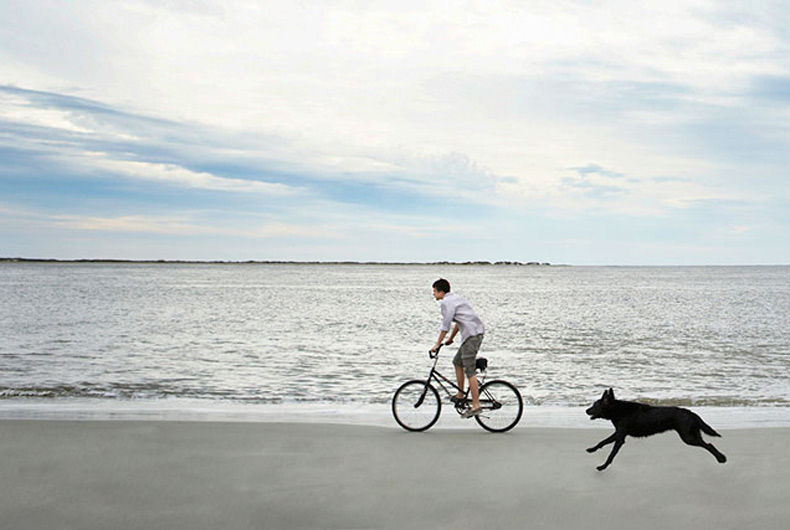
Gear you should own to ride your bike with your dog
At the least, you should have a comfortable harness and a special bungee-type leash that attaches to your bike to keep your dog close but allows some give if they should pull. Be sure the leash is short enough that your dog can’t get too far ahead or behind.
Here are a couple of leash options:
- A comfortable harness for your dog. Jerking on a collar is not going to be pleasant for them. This post on helping your dog feel comfortable in the car has some suggestions for harnesses that you can also use to secure your dog in the car.
- The Wefaner hands-free bicycle dog leash. This leash connects to a steel pole that attaches to your bicycle seat post so you can keep your hands on the handlebar. The leash has a stretchy piece of nylon that gives your dog some room to move without pulling you over.
- Malabi rotating dog leash. The advantage of this leash is that it swivels behind the bike so your dog can run on either side or switch back and forth.
- The MBB dog runner is more substantial than some other options as it includes a U-shaped bar preventing your dog from moving toward the bike. It has a quick-release bar that makes it easy to put on and off without tools.
Alternatives to having your dog run beside you
If you want to take your dog for a bike ride, but they are not suited to running alongside, there are a couple of other options.
Tow your dog in a trailer
If your dog is light enough, or you are a strong cyclist or have an electric bike, towing your dog behind you in a trailer is an enjoyable way to get some fresh air and enjoy the sights and smells without working hard. There are many trailers specific to towing dogs on the market now. A trailer designed to carry a child may also work for your dog.
Carry your small dog in a basket
If you have a small dog, they may enjoy riding with you by sitting in a basket in the front or back. Just be sure the basket is soft and comfortable for your dog and that they are firmly secured or the basket has a cover on it. If you connect your dog with a leash, make sure it is short enough that they can’t jump out of the basket or end up hanging by the leash.
Authors
By Christy True
Christy wrote about pets for Healthy Paws for 35 dog years. A background in journalism may be why she enjoys writing about offbeat animal studies and the latest viral pet trends. She has been owned by several dogs, including current pup Nelson, a rescued mini-Aussie, and she volunteers with a local dog rescue. In her free time, she can usually be found sliding down a mountain near her home in Bend, Ore. with Nelson in hot pursuit.
By Danette Johnston
Danette Johnston is the owner of Dog’s Day Out daycare and training center in Seattle. She has trained dogs (and people!) working in animal hospitals and shelters and worked as an animal-assisted therapy instructor. She started a Shelter Training Program in which she educates staff and volunteers at rescues to improve the lives of shelter animals. She currently shares her home with Ernie, a brown tabby with many extra toes, a 20-pound fluffy rescue dog named Boogie, one human teenager, and a very tolerant husband.