

Learn how and why veterinary bills are increasing, and how a Healthy Paws plan can help.

Read stories of how Healthy Paws has protected pets like family and made peace of mind and more happy, healthy moments possible.

Rescue organizations across the U.S. received support for adoption efforts and ongoing care for vulnerable pets.

Make their food irresistible with the freshest nutritionally-balanced ingredients.
The Healthy Paws Community is a vibrant, social-first space for all pet lovers—whether you’re a Healthy Paws policyholder or simply passionate about pets. As a Pack Member, you can share your favorite pet photos and videos, connect with fellow pet parents, and stay informed with the latest Healthy Paws news and tips. It’s a welcoming place focused on connection, positivity, and celebrating the joy pets bring to our lives!
Everyday expenses for a pet now exceed $4,000 a year on average, according to new research. As prices continue to climb, pet owners face tough choices. Pet insurance can be a financial backstop against the unexpected.

Introduction to Brussels Griffons
Belonging to the Toy Group category of dogs, the Brussels griffon is a dog breed known for being loyal, curious, and alert. These dogs weigh no more than 12 pounds and are sensitive and loving companions. They have round eyes, a sociable demeanor, and a strong personality.
A Brussels griffon may be the perfect dog for you if you are looking for a close canine companion in a tiny package. This Healthy Paws breed guide includes more about the breed, including temperament, characteristics, health, care, and feeding details.
Get a pet insurance quote for your Brussels Griffons today
Size of Brussels Griffons
One of the most distinctive things about the Brussels griffon is their size. When fully grown, these dogs typically only weigh between eight and 10 pounds. They stand seven to 10 inches tall as adults.
Below is a chart detailing how big you can expect your Brussels griffon to get as the dog grows from puppyhood to adulthood. Although some breeds have significant weight differences between males and females, Brussels griffons of both genders have approximately the same weight as they grow from birth up to 18 months and beyond.
| Weight Chart | 3 months | 6 months | 9 months | 12 months |
| Male and female Brussels griffons | 4-5.5 lbs. | 6-8.5 lbs. | 7-9.5 lbs. | 8-10 lbs |
Characteristics of Brussels Griffons
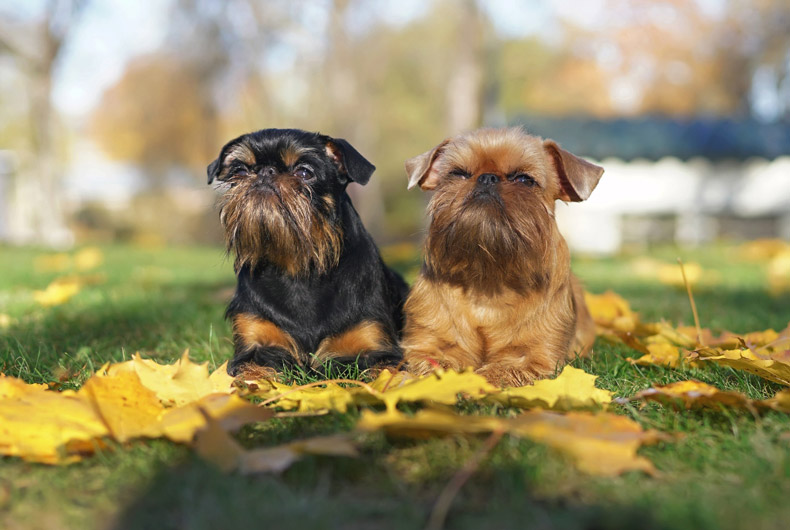
Brussels griffons are charming and adorable dogs with fun personalities. They are furry and affectionate, forming strong bonds with their pet parents and thriving on human companionship. These dogs are quick learners and need mental stimulation because of their high intelligence levels and tendency to get into trouble if they get bored.
However, it is important to know that Brussels griffons can also be stubborn, so you must be patient, positive, and consistent during training sessions. Although their exercise needs are moderate, they are very playful dogs with a lot of energy and enjoy spirited play sessions with their favorite people.
As you get to know a Brussels griffon’s personality, here’s what you can expect based on the breed characteristics:
| Breed Characteristic | Level (High, Medium, Low) |
| Affectionate with People | High |
| Good with Kids | Medium |
| Good with Pets | Medium |
| Need for Exercise | Medium |
| Energy Level | Medium |
| Intelligence Level | Medium |
| Able to Be Trained | Medium |
| Amount of Barking | Medium |
| Amount of Shedding | Medium |
History of Brussels Griffons
As the breed’s name suggests, Brussels griffons originated in Belgium. Their official story began in Belgium’s capital city of Brussels in the early 1800s. This was when the dog emerged from its previous role as a rat dog to become a sophisticated lap dog for royalty. Before this, a version of the breed existed throughout Europe, and its ancestors were used to hunt rats.
In Belgium, coachmen kept small, terrier-type dogs to control rat populations in stables. Although precise historical records do not exist, breed enthusiasts believe that Brussels griffons possibly resulted from the breeding of pugs, English toy spaniels, Brabancons (an old Belgian breed), and Yorkshire terriers.
In the 1870s, a Belgian queen fell in love with the breed and solidified its place among the royal patronage. The upper classes and kennel keepers refined the breed to make the body smaller and the face more humanlike, with round eyes, beards, and mustaches. Years later, the breed made its way to America, and the American Kennel Club registered its first Brussels griffon in 1910. U.S. and British breed enthusiasts kept the breed alive following the two World Wars, and a Brussels griffon was featured in the 1997 Jack Nicholson movie, “As Good as it Gets.”
Brussels Griffon Standard Information
The Brussels griffon breed standard describes the ideal characteristics of this dog and serves as a basis for judging it at shows.
Here is an overview of the breed standard information for Brussels griffons:
Head:
- Humanlike expression
- Eyes set apart, large, black, and prominent
- Skull is round and large with a domed forehead
- Nose is very black and short, with large nostrils
- Lips edged with black
- Jaws are undershot
- Lower jaw is prominent and rather broad
Neck, Topline, Body:
- Medium-length neck that is graceful and arched
- Back is level and short
- Tail is held high and docked to 1/3 if docked
Forequarters:
- Medium length, straight in bone, and well-muscled
- Pasterns are short and strong
- Feet are round, small, and compact
- Toes are well-arched
- Black pads and fingernails
Hindquarters:
- Strong and well-muscled thighs
- Stifles bent
- Hocks well let down
Coat:
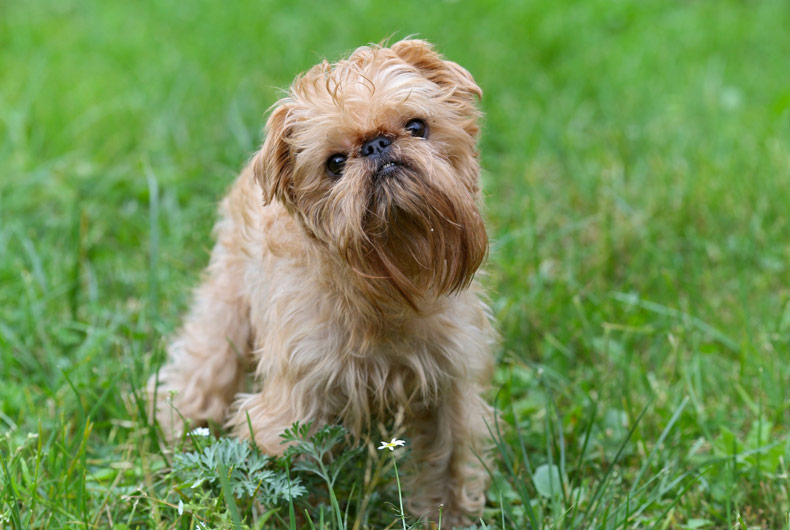
- Rough coat that is wiry and dense
- Smooth coat is short, straight, tight, and glossy
- No shaggy appearance
- Hand-stripped and never unkempt
- Coats should not be prepared with scissors or clippers
Color:
- Red (reddish brown with black at the whiskers and chin allowable)
- Belge (black and reddish brown mixed, black mask and whiskers)
- Black and tan (black with uniform reddish-brown markings)
- Solid black
Gait:
- Straightforward, purposeful trot with moderate reach and drive
- Maintains a steady topline in movement
Caring for Brussels Griffons
Brussels griffons make excellent apartment dogs because of their small size, ease of care, and love of being around humans. They are not very tolerant of hot or cold weather, nor of being left alone. You’ll need to secure your yard with a Brussels griffon because the breed has a high wanderlust potential.
Because of their small size and energy level, these dogs make great indoor pets. However, they still need regular exercise to stay in shape and content.
Here are some general tips for taking the best care of a Brussels griffon:
Best Living Environments:
- Homes or apartments of any size
- Yards aren’t necessary as long as dogs are walked frequently
- Climates that aren’t too hot or cold
- Households with older children (younger children may be too rough with them)
Type of Exercise:
- Playtime indoors or in a yard or dog park
- Daily walks
Mental Enrichment:
- Agility, obedience, and tracking sports
- Puzzle games
Training Strategies:
- May need to persuade a Brussels griffon to participate in training
- House training may be a challenge
- Consider crate training to prevent bathroom accidents
Grooming Tips:
- Can be rough-coated or smooth-coated
- Keep the coat always neat and tidy
- Rough-coated griffons require more grooming than smooth-coated dogs
- Brush rough coats weekly with a natural bristle brush
- Comb rough coats with a medium-tooth metal comb after brushing
- Hand stripping every few months will maintain the wiry texture of a rough coat
- Clipping is an option for pet dogs with rough coats
- Weekly brushing and occasional baths for smooth-coated griffons
- Brush teeth daily
- Trim nails and clean ears as needed

Common Health Problems of Brussels Griffons
The average life expectancy for a Brussels griffon is 12 to 15 years. These are robust and resilient dogs that are generally healthy. However, their past breeding and genetics lead them to be at risk of certain health conditions that pet parents should know about.
These are some of the most common health issues that arise with Brussels griffons:
- Medial patella luxation
- Hip dysplasia
- Cataracts
- Progressive retinal atrophy
- Eye injuries due to prominent eyes
- Tartar buildup and dental issues
- Syringomyelia
Diet and Nutrition for Brussels Griffons
Most adult Brussels griffon will thrive when eating high-quality, nutritionally complete and balanced adult dog food. Puppies should eat puppy food until they are around nine months old. These small dogs need to eat more frequently than big dogs to prevent their blood sugar levels from dropping, particularly as puppies. Therefore, you may need to feed your Brussels griffon puppy five small meals per day and keep the meals about four hours apart to prevent hypoglycemia. Adults generally do well with two to three meals a day. If you feed your Brussels griffon homemade dog food, make sure you are working from a recipe that is designed by a veterinary nutritionist and that is appropriate for your dog’s age and health status.
Feed the amount of dog food needed to keep your pet slim. You should be able to see your Brussels griffon’s waist and feel (but not see) their ribs without having to press too hard. In general, puppies need more calories per day than adults, but a dog’s needs will vary with their activity level and other factors. Don’t leave food out all day for a Brussels griffon to graze on.
Talk to your veterinarian if you have any questions about your Brussels griffon’s diet or health.
Where to Adopt or Purchase Brussels Griffons
The American Brussels Griffon Association is an American Kennel Club member organization that sets the standards by which these dogs are judged at dog shows. Its website offers information on how to connect with breeders and purchase available Brussels griffons.
It also provides information about National Brussels Griffon Rescue, a volunteer-led network committed to rescuing, treating, and rehoming dogs of this breed that have been lost, abandoned, surrendered, or abused. Through this group, you can adopt, foster, donate, or volunteer to support Brussels griffons in need.
Pet Insurance for Brussels Griffons
One of the best things you can do to care for your Brussels Griffon is to sign your pup up for pet insurance through Healthy Paws. We offer Brussels Griffon health insurance to cover new accidents and injuries, as well as cancer care, emergency care, breed-specific and genetic conditions, and alternative care.
You can take your Brussels griffon to any licensed veterinarian you trust and quickly and easily submit vet bills to us through our website or mobile app. We offer flexible premium and deductible options to make pet insurance affordable, valuable, and always worth it to give you peace of mind. We have been the #1 customer-rated pet insurance plan for seven years in a row. Never worry about the high costs of veterinary care again!
Get your Brussels griffon insurance quote today, and contact us to learn more about the benefits of pet insurance.
Authors
Stacy Painter
Stacy has always been an animal lover and has worked in the pet industry and pet insurance specifically for over a decade. As a writer since early childhood, content writing for Healthy Paws pet insurance was a natural career path to combine her two passions. She currently lives in Florida with her boyfriend and Taiwanese rescue dog, Kaya.
Jennifer Coates, DVM
Dr. Jennifer Coates received her Bachelor of Science degree in biology from McGill University in Montreal, Quebec, Canada. After graduation, she worked for several years in the fields of conservation and animal welfare before pursuing her childhood dream—becoming a veterinarian. She graduated with honors from the Virginia-Maryland Regional College of Veterinary Medicine and has worked as an Associate Veterinarian and Chief of Staff in Virginia, Wyoming, and Colorado. Jennifer is also a prolific writer about all things related to veterinary medicine and the well-being of our animal friends. She has published several short stories and books, including the Dictionary of Veterinary Terms, Vet-Speak Deciphered for the Non-Veterinarian. She currently contributes to the Healthy Paws pet insurance blog as a freelance writer. In her free time, Jennifer enjoys life in Colorado with her family and friends… many of whom walk on four legs.