Compare coverage and benefits to see if Healthy Paws is the right fit for your family.
Learn how and why veterinary bills are increasing, and how a Healthy Paws plan can help.
Read stories of how Healthy Paws has protected pets like family and made peace of mind and more happy, healthy moments possible.
Three rescues across North Carolina and Georgia received donations that made a big impact.
Make their food irresistible with the freshest nutritionally-balanced ingredients.
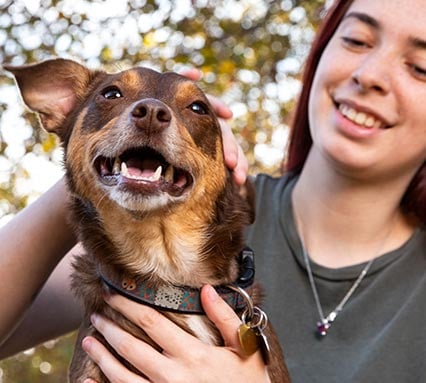
When you take your dog for a walk or send him into the yard, you’ve probably noticed he immediately puts his nose to work tracking squirrels, rabbits and the meter man. Airflow, moisture, temperature and density all influence how easily he tracks a smell.
An amazing feat of evolution, the dog’s nose is capable of distinguishing more than 1,000 individual chemical odorants. The dog’s nose surpasses the human nose at least 10,000 times over. In addition to a proportionately large nasal cavity, the dog also possesses a special organ called the vomeronasal organ. The VMO helps the dog distinguish between organic smells and inorganic smells. For organic smells, it provides biological information on, gender, species, health status, mood and more, giving the dog a complete picture of the animal they are smelling.
To get an idea of how scent travels in the air, fill a glass with water, then place two to three drops of food coloring into the glass. Watch how it changes. It moves from high to low elevation, gets caught in swirls of movement and dissipates as it moves further away from the origination point.
Moisture and temperature affect the strength of scents as well as how quickly they dissipate. Water vapor traps scent molecules, enhancing the odor they release and retarding their diffusion into the air. When the temperature drops, air and scent molecules become more dense, resulting in a higher concentration of smell per square inch. This is because scent molecules move closer together when cold. The combination of moist, cool air results in scent that is heavy and closer to the ground. This makes it much easier for a dog to track the smell.
While it is true that cool, moist air makes it easier for dogs to smell and track odor, it is also true that air can be too cold for scent. This is because as temperatures continue to drop, the moisture in the air freezes to a solid. Eventually, the scent becomes trapped in dry solids and cannot be detected easily by the dog. It is for this reason that dogs may have trouble tracking in subzero temperatures but do well on cool, rainy days.
Want to learn more about your pup? Check out Scent Games for Dogs, Smells That Repel Dogs, and Can Dogs Smell Their Way Back Home? at Cuteness.com!
This article is provided by Cuteness—the go to destination for passionate pet parents. Cuteness has answers to all of your health, training, and behavior questions – as well as the cutest, funniest, and most inspiring pet stories from all over the world.
Cuteness Team
Cuteness is the place for pet people. Whether you’re looking for adoption guides, in-fur-mation on your pet’s weird habits or showcases of pure pet cuteness, we’ve paw-sitively got it all. At Cuteness, we’re committed to working only with experts we’d trust with our own pets. We’ve done the legwork for you so you can focus your energy on loving and caring for your furry friends. We’re passionate about all things pet and fostering a community of pet lovers. Caring for pets isn’t always a walk in the park – but we’ve got you covered! Cuteness and Healthy Paws Pet Insurance had a content sharing agreement until 2021.