
Learn how and why veterinary bills are increasing, and how a Healthy Paws plan can help.

Healthy Paws protects pets like family and makes peace of mind and more happy, healthy moments possible. Pet parents and industry reviews tell the story.

Rescue organizations across the U.S. received support for adoption efforts and ongoing care for vulnerable pets.

Make their food irresistible with the freshest nutritionally-balanced ingredients.
The Healthy Paws Community is a vibrant, social-first space for all pet lovers—whether you’re a Healthy Paws policyholder or simply passionate about pets. As a Pack Member, you can share your favorite pet photos and videos, connect with fellow pet parents, and stay informed with the latest Healthy Paws news and tips. It’s a welcoming place focused on connection, positivity, and celebrating the joy pets bring to our lives!

At a glance
- The Emotional Bond: 77% of owners view pets as "like a child," but 76% say rising vet costs force them to set hard financial limits on care.
- Low Stress Thresholds: More than 50% of owners report "significant stress" from a bill under $1,000; for 1 in 5, any surprise bill causes a strain.
- Deciding on Care: Roughly 1 in 3 owners would consider declining a life-saving treatment if the cost exceeds $1,000.
- The Insurance Advantage: Insured owners are nearly 50% more likely to approve all recommended treatments regardless of cost.
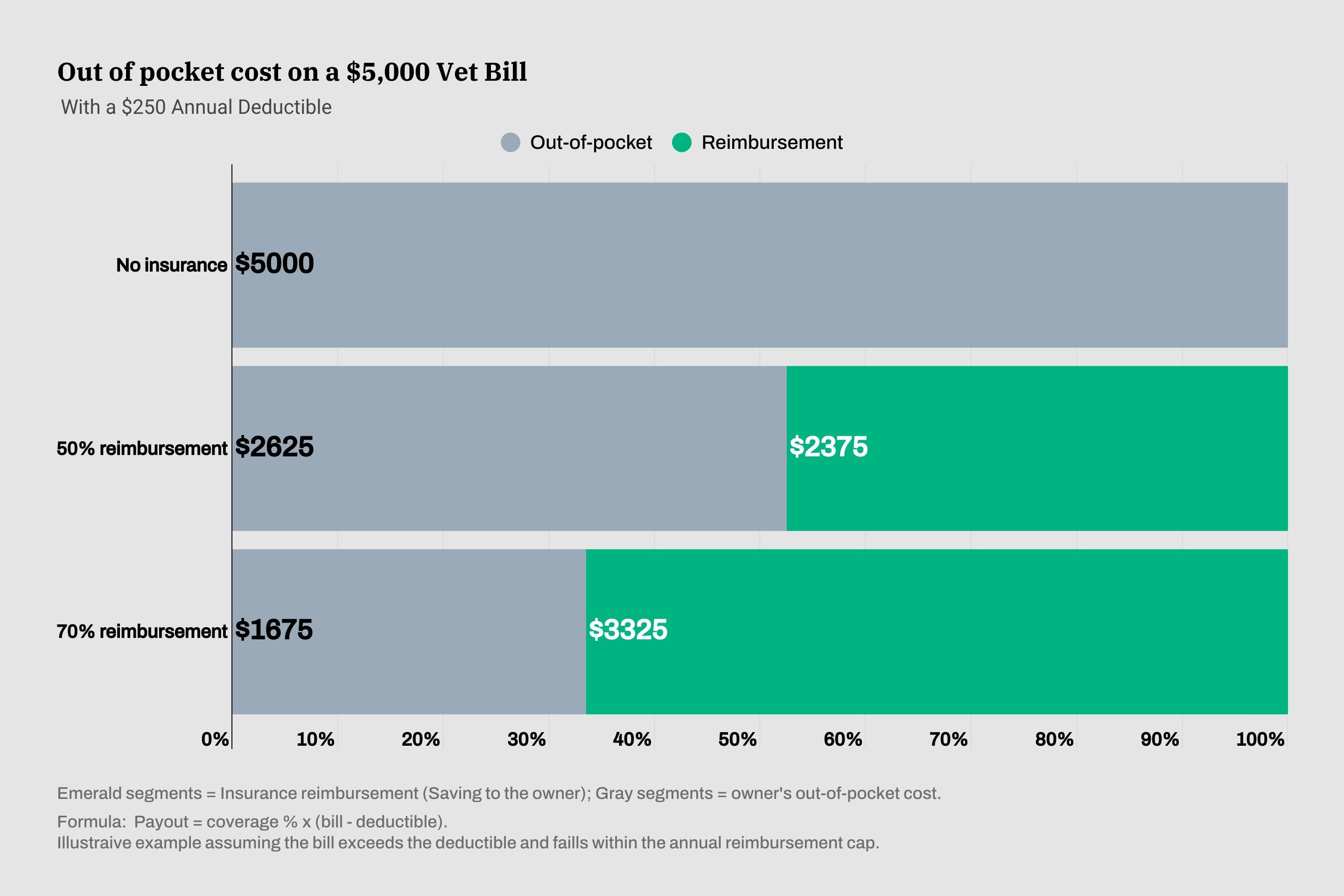
- Cost Containment: On a typical $5,000 emergency bill, 70% insurance reimbursement can reduce an owner's out-of-pocket cost to $1,675.
Table of Contents
- Strong Majorities Say They Would Go Into Debt to Save a Pet
- When Unexpected Vet Bills Become Financially Stressful
- Cost Threshold to Decline Vet Care
- The Insurance Difference
New research from Money.com and Healthy Paws Pet Insurance shows how soaring vet costs are forcing pet owners to draw hard financial lines.
For millions of Americans, pets now occupy an emotional space once reserved almost exclusively for human family members. They shape daily routines and travel plans, influence household budgets and dictate everything from the size of their owners’ backyards to how quickly they rush home after work.
According to new research from Healthy Paws Pet Insurance and Money.com, which surveyed more than 1,500 cat and dog owners across the U.S., 77% of pet owners agree their animals are “like a child” to them.
But as veterinary costs continue to climb, emotional devotion and financial reality are increasingly colliding. In the same survey, nearly the same share of owners (76%) said there is a cost threshold at which they would consider declining a recommended veterinary treatment for their pet. For about a third of respondents, that threshold is less than $1,000.
The findings reflect two realities: Pets have never been more loved, and the cost of caring for them is pushing families toward the financial brink.
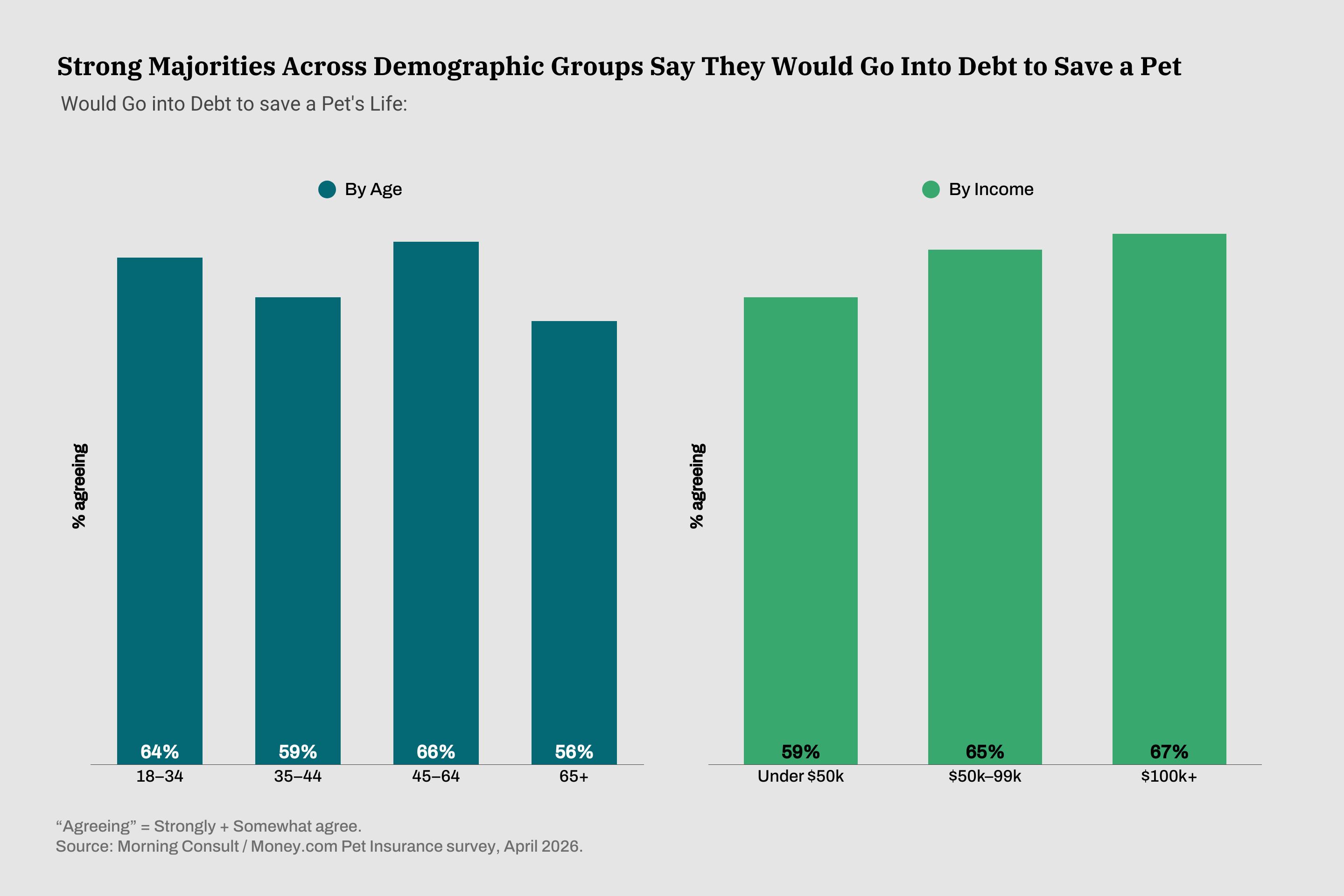
Strong Majorities Across Demographic Groups Say They Would Go Into Debt to Save a Pet
Pets are more deeply woven into American life than ever before. In many cities, they roam the halls of pet-friendly workspaces before returning home to apartment buildings with rooftop dog parks, lobbies stocked with treat jars and on-site pet baths. In the suburbs and beyond, doggy daycare waitlists can rival those of nearby preschools, and subscription meal kits for otherwise ordinary cats and dogs have moved firmly into the mainstream.
These trends may feel distinctly modern, but the mindset driving them is remarkably widespread. Across demographic groups spanning geography, household size, marital status and income, strong majorities agree their pet is "like a child" to them.
Somewhat counterintuitively, agreement runs highest among older respondents: 81% of pet owners ages 45 and older said yes, compared with 75% of those 35 to 44 and 72% of those 18 to 34.
For many owners, financial tradeoffs come with the territory. About 73% of respondents said they would sacrifice personal luxuries to pay for their pet's medical care, and 62% said they would go into debt to save their pet's life — findings that were also broadly consistent across demographics.
That devotion comes with a growing price tag.
Veterinary costs have surged, rising 60% over the last decade. Several factors have contributed to higher care costs, including inflation, rising operational expenses and medical advancements. Emergency cases can be particularly costly: Depending on the diagnosis, owners may face bills ranging from a few hundred dollars to several thousand dollars. Major surgeries, hospitalizations and complex medical cases can exceed $10,000.
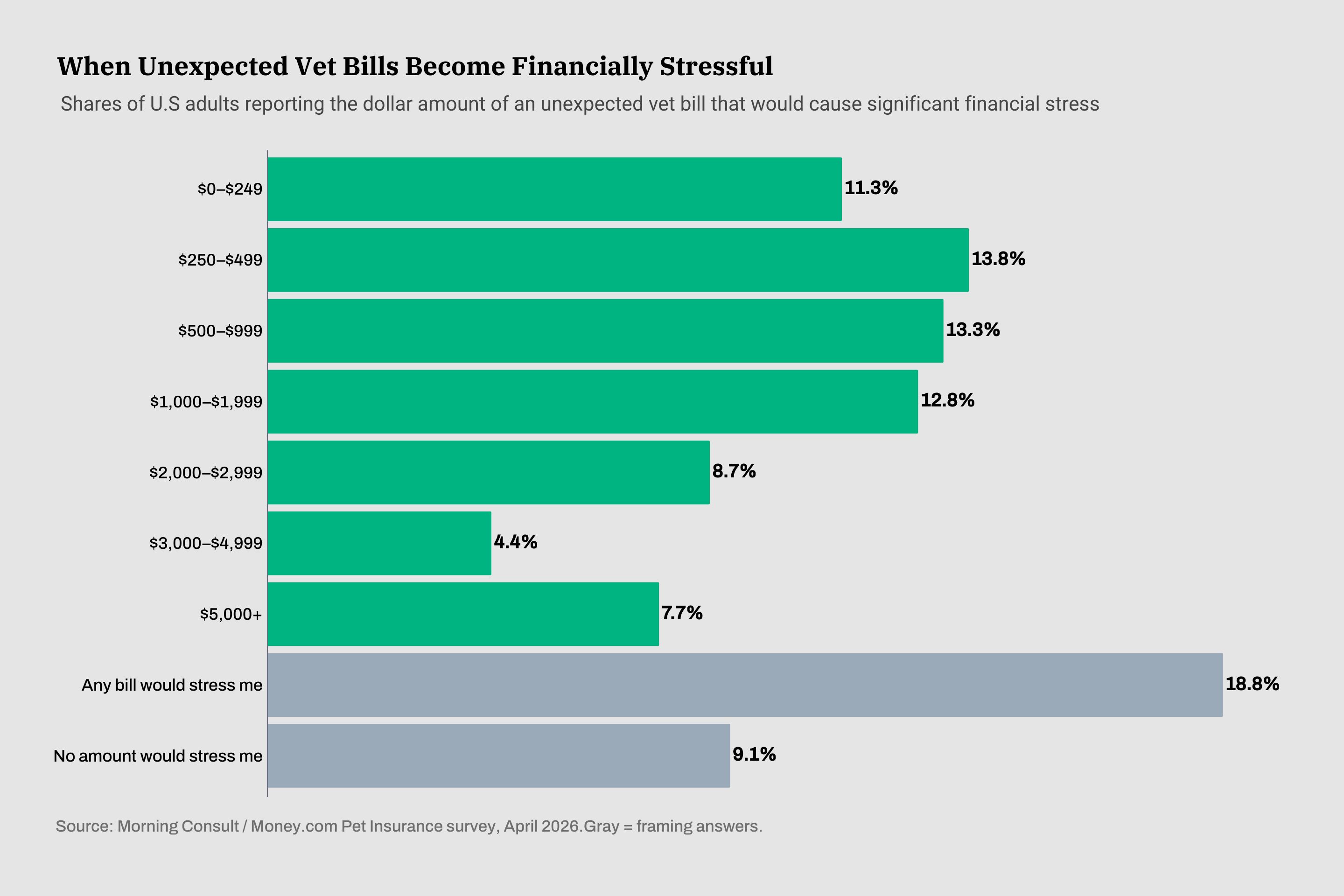
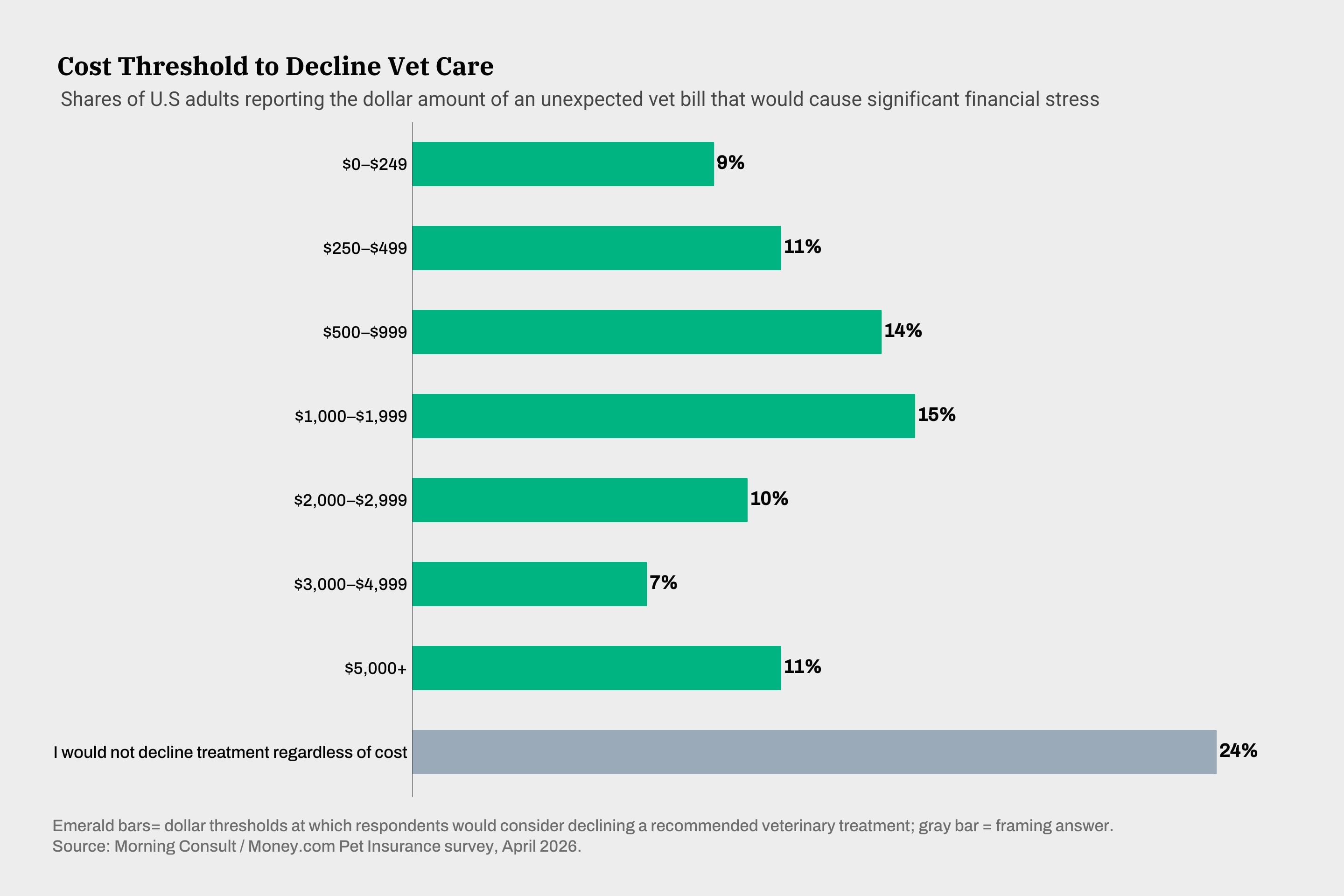
For many households, a single unexpected bill can upend a budget. More than half of pet owners polled by Money and Healthy Paws said an unplanned vet bill under $1,000 would cause “significant financial stress,” and nearly one in five said any surprise vet expense, regardless of size, would strain their finances.
When Unexpected Vet Bills Become Financially Stressful
Financial vulnerability is widespread, even among more affluent households. Among those earning more than $100,000 annually, nearly half (44%) said a veterinary bill below $2,000 would cause significant financial stress.
For some pet owners, debt has become a way to preserve access to care. Nearly one-quarter of pet owners (24.1%) surveyed said they have used a credit card and carried a balance to pay for pet care expenses. Among owners who turned to a credit card or another type of financing, roughly 29% said repayment took seven months or longer — or is still ongoing.
Financial limits begin to reshape care decisions quickly. In the survey, roughly three-quarters of pet owners identified a cost threshold at which they would consider declining a recommended veterinary treatment for their pet, and about a third drew the line below $1,000.
Cost Threshold to Decline Vet Care
Dr. Rachel Pound, lead veterinarian at Paradise Animal Hospital in Catonsville, Maryland, says those tradeoffs are becoming increasingly common.
“Appointment openings ebb and flow with economic changes,” she says. “There have certainly been times when a pet has not received ideal care due to financial constraints.”
Pet insurance is softening some of that financial pressure, particularly during major medical events.
Among insured pet owners, more than half (54%) said their insurance reimbursed at least half the cost of a significant veterinary expense.
In practice, that can fundamentally change the economics of emergency care. A multi-thousand-dollar surgery or cancer treatment that might otherwise be unaffordable becomes much more manageable when insurance covers a large share of the bill.
That security appears to shape decisions at the vet's office: Insured pet owners are significantly more likely to pursue all recommended treatments regardless of cost (47%) than pet owners overall (32%), according to the survey.
The Insurance Difference
As For some, the difference is stark.
“My dog wound up having two chronic illnesses, a surgery, multiple ruptured glands, a parasite and some trips to the emergency vet,” says Sage Curtis, a copywriter and dog owner in San Jose, California.
Without insurance, Curtis estimates the total bill would have exceeded $8,000 — a cost she says would have been "completely out of reach." With insurance, her out-of-pocket expenses came to less than $1,600, including her deductible. "It was still expensive, but much more manageable," she says.
For Noah Stone, a photographer and co-founder of the Los Angeles-based clothing brand Rowan, insurance shaped not just the cost of care, but the care itself.
When his dog, Buddy, needed radiation, the coverage made the choice straightforward. "It more than halved the cost and bought him another two pain-free years," he says. "Whenever something came up … I never had to hesitate."
As veterinary medicine evolves, more pet owners must weigh what they want to do for their animals against what they can realistically afford.
Pet insurance is not a cure-all. Coverage varies widely, and many owners only begin exploring insurance after a pet has developed conditions that may no longer be covered.
But for owners facing serious diagnoses or emergency care, insurance can close the gap between what treatment is available and what they can comfortably pursue.
"It only takes one extensive hospitalization, emergency procedure [or] complex case that requires extensive testing to diagnose … for it to pay for itself,” Pound says.
Methodology
This survey was conducted by Morning Consult on behalf of Money.com and Healthy Paws Pet Insurance from April 20–23, 2026, among a national sample of 1,542 pet owners. Respondents were required to own at least one dog or cat to qualify for participation.
The data were weighted to reflect the composition of U.S. dog and cat owners based on key characteristics. The margin of error is plus or minus 2 percentage points.

Meet Our Writer
Steph Weaver
Steph Weaver is a Philadelphia-based journalist and copywriter who writes frequently about pet health and the economics of pet care. Her work has appeared in Inc., Money and This Dog's Life, where she's reported on everything from fear-free veterinary care to pet insurance. She specializes in turning research into clear, actionable guidance for readers.