
Learn how and why veterinary bills are increasing, and how a Healthy Paws plan can help.

Healthy Paws protects pets like family and makes peace of mind and more happy, healthy moments possible. Pet parents and industry reviews tell the story.

Rescue organizations across the U.S. received support for adoption efforts and ongoing care for vulnerable pets.

Make their food irresistible with the freshest nutritionally-balanced ingredients.
The Healthy Paws Community is a vibrant, social-first space for all pet lovers—whether you’re a Healthy Paws policyholder or simply passionate about pets. As a Pack Member, you can share your favorite pet photos and videos, connect with fellow pet parents, and stay informed with the latest Healthy Paws news and tips. It’s a welcoming place focused on connection, positivity, and celebrating the joy pets bring to our lives!

Introduction to Keeshonden
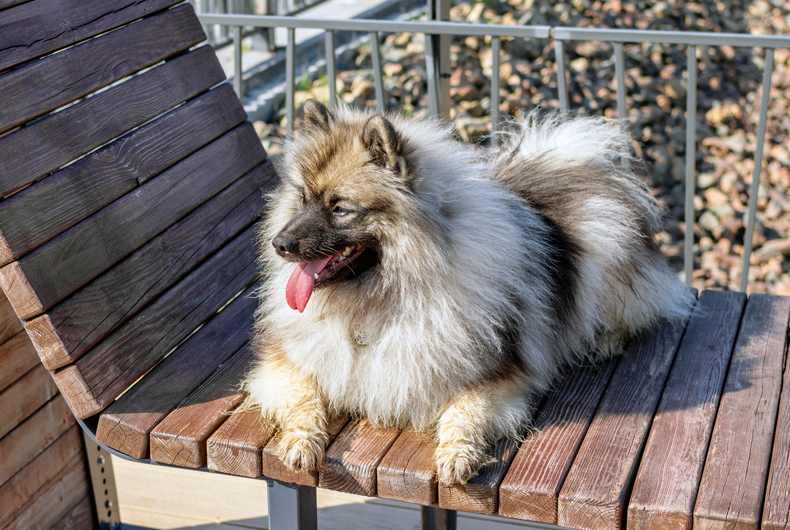
The Keeshond (plural Keeshonden) is a unique dog breed and a non-sporting group dog known for its foxy face and plush coat. This spitz-type dog has markings around the eyes, affectionately called "spectacles." This feature gives the dog an intelligent and alert expression.
Beyond its physical appearance, the Keeshond loves people and adapts to different environments and family situations. It is a rare breed that you might not have heard of before or seen in real life, movies, or TV shows. In this Healthy Paws breed guide, we cover the Keeshond’s size, characteristics, care, health, and other things to know if you’d like to bring one of these beautiful dogs into your life.
Size of Keeshonden
When fully grown, a Keeshond will weigh between 35 and 45 pounds. A Keeshond will be its final adult size at two years of age. Females stand about 17 inches tall, and males are about 18 inches tall.
Here’s how big you can expect your Keeshond to get as the dog grows from puppyhood to adulthood. Males tend to be slightly more than these averages, while females are somewhat lower.
| Weight Chart | 6 months | 12 months | 18 months |
| Average Male or Female Keeshonden | 20 lbs. | 30 lbs. | 37.5 lbs. |
Characteristics of Keeshonden
Keeshonden are all-around friendly dogs with moderate exercise needs. They aren’t the most effective guard dogs because they can accept and love pretty much anyone. They get along well with other dogs if socialized from an early age and are beloved family pets. Keeshonden are sensitive, tolerate cold weather better than hot weather, and are known for shedding a reasonable amount.
As you get to know a Keeshond’s personality, here’s what you can expect based on the breed characteristics.
| Breed Characteristic | Level (High, Medium, Low) |
| Affectionate with People | High |
| Good with Kids | High |
| Good with Pets | High |
| Need for Exercise | Medium |
| Energy Level | Medium |
| Intelligence Level | High |
| Able to Be Trained | High |
| Amount of Barking | Medium |
| Amount of Shedding | Medium |
History of Keeshonden
Historians believe the Keeshond's earliest roots may date back to the Arctic or sub-Arctic regions. The dogs are most closely linked to the Netherlands, where these hardy and nimble-footed dogs were bred to stand guard and serve as companions on Dutch barges that sailed on Rhine waterways. These people-pleasing dogs symbolized the Dutch Patriots Party in the 18th century and were considered a Dutch mascot dog. For that reason, the dogs were featured in Dutch political cartoons to depict the strive and struggles of the local people.
After the associated political party was overthrown, the Keeshond’s population diminished. But in the early 1900s, Miss Hamilton-Fletcher rediscovered the breed and had her parents take two puppies back to England. This is where the breed was first introduced outside of the Netherlands and where an English breed club formed. In the following years, Keeshonden were still used on riverboats and farms. The first American Keeshonden were bred in 1929, and the American Kennel Club registered the breed in 1930.
Keeshond Standard Information
The official Keeshond standard describes the dog as well-balanced and naturally handsome, with a short-coupled body and intelligent expression. A pure Keeshond must adhere to many physical and temperament characteristics for the dog to be judged favorably at shows and competitions.
Here is an overview of the breed standard information for Keeshonden:
Head:
- Dark line slanting from outer corners of eyes
- Expressive eyebrows
- Dark brown eyes of medium size
- Small and triangular ears mounted high on the head
- Head is well-proportioned to the body
- Muzzle is medium length and not coarse or snipey
- Lips are black and closely meeting
- Teeth are white and meet in a scissors bite
Neck, Topline, Body:
- Neck is moderately long and well-set on shoulders
- Body is compact and slopes slightly down toward hindquarters
- Tail is moderately long, well-feathered, set on high, and tightly curled over the back
Forequarters:
- Should be straight seen from any angle
- Pasterns are strong with a slight slope
- Shoulder to upper arm angulation is slight to moderate
Hindquarters:
- Angulation in the rear is slight to moderate
- Well-muscled and with hocks that are perpendicular to the ground
Coat:
- Body has abundant coverage with long, straight, harsh hair
- Smooth, soft, velvety hear on the head, muzzle, skull, and ears
- Leg hair is smooth and short except for front leg feathering and hind leg “trousers”
- Coat does not part down the back
- Trimming allowed only on the feet, hocks, pasterns, and whiskers
Color:
- Mixture of gray, black, and cream
- Dramatically marked dog, but less so as puppies
- Undercoat is pale gray or cream
Gait:
- Bold movements with tails curled over the back
- Clean and brisk movement
- Reach and drive from slight to moderate
Caring for Keeshonden
Keeshonden are people-loving dogs that hate being left alone. For this reason, they do not make good backyard dogs and will not thrive without human attention. In fact, too much time alone will lead a Keeshond to bark excessively and chew destructively.
Although first-time pet parents can typically handle Keeshonden, it’s a good idea to start training sessions early in the dog’s life so that you have an obedient and well-adjusted dog that understands boundaries while you show your love and patience.
Here are some general tips for taking the best care of a Keeshond:
Best Living Environments:
- Can live in apartments if properly exercised
- Households where dogs are not left alone for long periods of time
- Cool environments rather than very hot ones
- Homes with a fenced yard for playtime with family members
Type of Exercise:
- Backyard playtime
- Walks in the neighborhood
- Plan on an hour of exercise daily
- Jogging short distances (at a leisurely pace and not more than a mile or two)
- Hiking up to four miles, preferably when it’s cool outside
Mental Enrichment:
- Agility competitions
- Rally competitions
- Obedience rings
- Conformation rings
- Indoor time with family members
Training Strategies:
- Generally easy to train and responsive to commands
- Practice bark-related training commands
- Make leash training a priority
Grooming Tips:
- Prepare for frequent vacuuming due to shedding
Common Health Problems of Keeshonden

The average life expectancy of a Keeshond is 12 to 15 years. To help your Keeshond live a long and healthy life, it is important to recognize health concerns and bring them to the attention of your veterinarian.
These are some of the most common health issues that arise with Keeshonden:
- Hip and elbow dysplasia
- Epilepsy
- Cataracts
- Progressive retinal atrophy
- Addison’s disease
- Von Willebrand’s disease
- Diabetes mellitus
- Thyroid disorders
- Allergies
- Patellar luxation
- Dental disease
- Primary hyperparathyroidism
Where to Adopt or Purchase Keeshonden
Founded in 1935, the Keeshond Club of America is the national breed club for Keeshonden. The club recommends that breeders conduct various health tests to identify potential concerns, including x-rays to check for hip and elbow dysplasia, a patellar luxation exam, an ophthalmologist evaluation, and genetic screening for hyperparathyroidism.
The club also provides a breeder listing organized by city and state and a list of rescue organizations that help Keeshonden find loving homes. To adopt a pet, you can also contact volunteer-led nonprofit organizations like Bay Area Rescue Keeshonden, Inc.

Related Breeds
If you like what you’ve learned so far about the Keeshond breed, then you might also be interested to learn about other similar breeds, such as these:
- German spitz
- Icelandic sheepdog
- American Eskimo dog
- Samoyed
- Chow Chow
- Norwegian elkhound
- Finnish spitz
- Pomeranian
Pet Insurance for Keeshonden
Keeshonden are amazing dogs that are a pure joy to be around and let into your life. If you have purchased or adopted a Keeshond, consider signing your pup up for pet insurance so that you can focus on your pet's well-being and not the rising costs of veterinary care.
Healthy Paws offers Keeshond pet insurance with one easy-to-understand policy and no costly add-ons. You can use any licensed vet you trust when your Keeshond isn’t feeling well and get help paying for care related to accidents, illnesses, emergency visits, breed-specific and hereditary conditions, emergency care, or cancer. With our flexible premium and deductible options, you can't afford NOT to have Healthy Paws coverage as your Keeshond progresses through the stages of life from puppyhood to senior dog status.
Please contact us today for your Keeshond pet insurance quote, or contact our customer service team with any questions about how pet insurance works.