

Learn how and why veterinary bills are increasing, and how a Healthy Paws plan can help.

Healthy Paws protects pets like family and makes peace of mind and more happy, healthy moments possible. Pet parents and industry reviews tell the story.

Rescue organizations across the U.S. received support for adoption efforts and ongoing care for vulnerable pets.

Make their food irresistible with the freshest nutritionally-balanced ingredients.
The Healthy Paws Community is a vibrant, social-first space for all pet lovers—whether you’re a Healthy Paws policyholder or simply passionate about pets. As a Pack Member, you can share your favorite pet photos and videos, connect with fellow pet parents, and stay informed with the latest Healthy Paws news and tips. It’s a welcoming place focused on connection, positivity, and celebrating the joy pets bring to our lives!
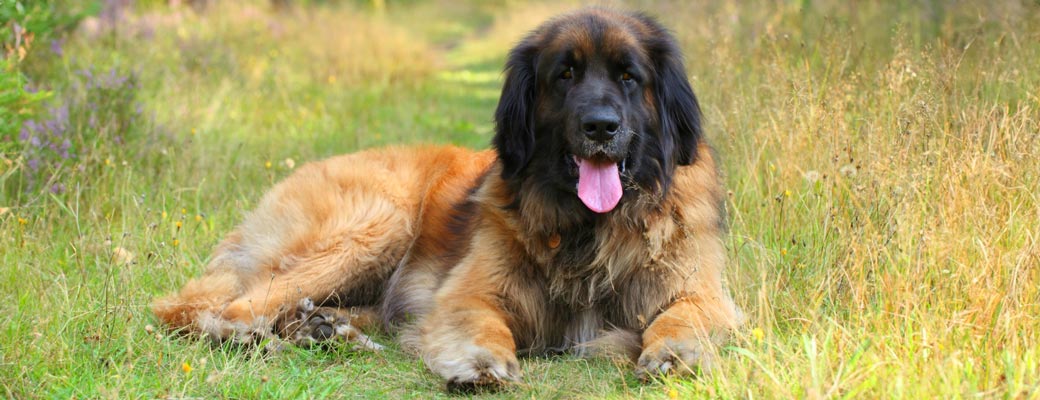
Introduction to Leonbergers
The Leonberger is a gentle giant breed from Germany that makes a wonderful family dog. These dogs are great with kids but require a good amount of exercise and grooming. Leonbergers often make effective watchdogs and are intelligent pets who train easily and are eager to learn.
In this Healthy Paws guide, we share everything you need to know about Leonbergers to help you decide whether this is the right pet for your lifestyle and how to take the best care of your dog’s health.
Size of Leonbergers
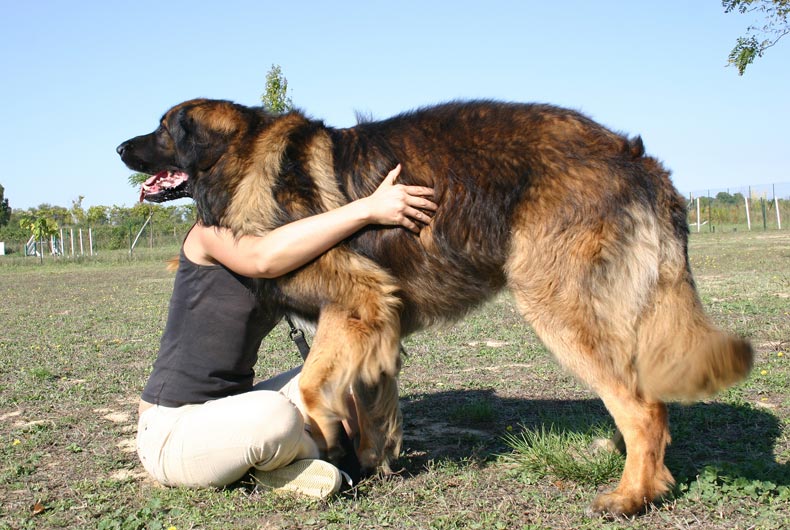
An adult male Leonberger weighs 110 to 170 pounds and stands 28 to 31.5 inches tall. Females are 90 to 140 pounds and 25.5 to 29.5 inches tall.
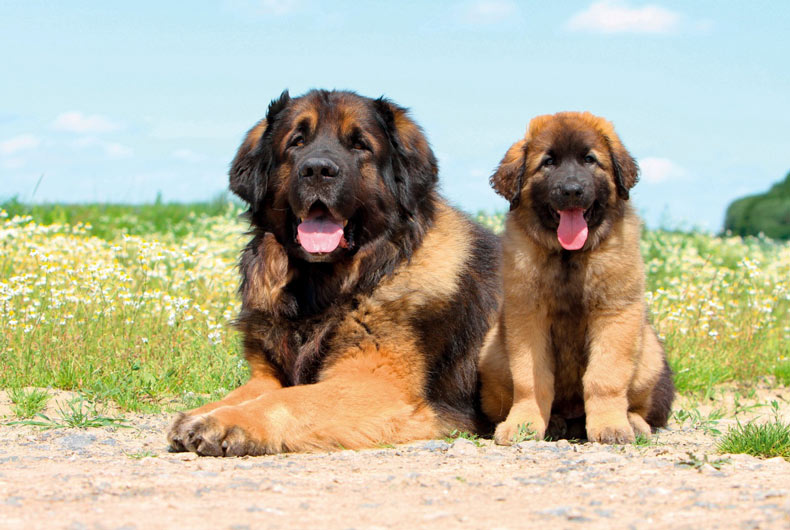
Here’s how big you can expect your Leonberger to get as the dog grows from puppyhood to adulthood:
| Average Weight | 6 months | 12 months | 18 months |
| Male Leonbergers | 70 lbs. | 105 lbs. | 145 lbs. |
| Female Leonbergers | 60 lbs. | 90 lbs. | 117.5 lbs. |
Characteristics of Leonbergers
Leonbergers are large working dogs that are affectionate and loyal. Their temperament is also described as obedient, fearless, calm, and companionable.
They love spending time with family members, especially kids, but are hesitant with strangers. You’ll need to devote a significant amount of time to exercise and playtime with your Leonberger and brush your dog’s long, thick coat regularly to prevent mats.
As you get to know a Leonberger’s personality, here’s what you can expect based on the breed characteristics:
| Breed Characteristic | Level (High, Medium, Low) |
| Affectionate with People | Medium |
| Good with Kids | High |
| Good with Pets | Medium |
| Need for Exercise | Medium |
| Energy Level | Medium |
| Intelligence Level | High |
| Able to be Trained | High |
| Amount of Barking | Medium |
| Amount of Shedding | High |
History of Leonbergers
Heinrich Essig, a 19th-century entrepreneur and politician, is credited with developing the Leonberger breed. Essig was from Leonberg, Germany, hence the breed’s name. He developed the breed as a human companion, but it is also considered a working dog with royal connections.
Napoleon III, Tsar Alexander II, and the Prince of Wales/King Edward VII all had Leonbergers. Leonbergers are versatile working dogs that did well on waterfronts, pastures, and farms. They are great swimmers and cart-pullers. They were used as messengers, ambulance dogs, and guard dogs for World Wars I and II military camps.
The American Kennel Club did not recognize the breed until 2010. Today, Leonbergers are primarily family pets in loving households.
Leonberger Standard Information
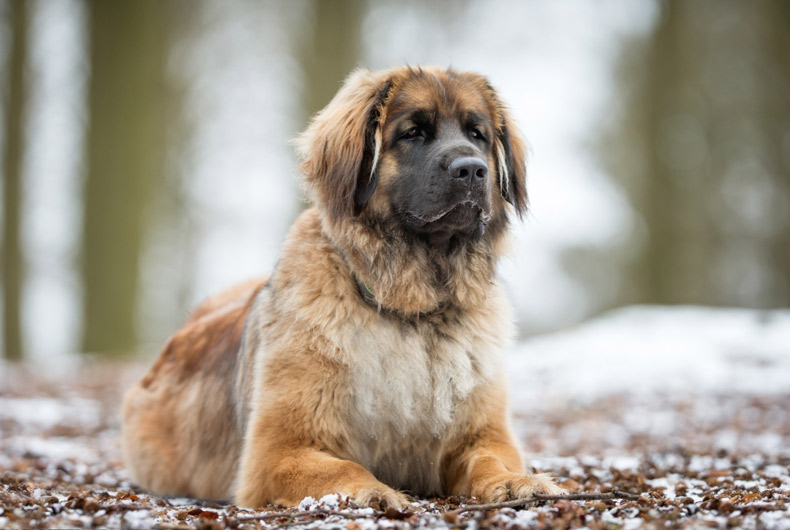
A Leonberger is generally muscular, elegant, sociable, and strong. They have black masks, a double coat, and a lion-like mane. It is typically easy to distinguish between male and female dogs of this breed, because males are taller and bulkier, with a more prominent mane.
Here is an overview of the breed standard information for Leonbergers:
Head:
- Deeper than broad
- Rectangular shaped
- Masculine or feminine characteristics
- Full black mask
- Soft and intelligent expression
- Dark brown eyes are preferred
- Ears are level with the top of the skull when alert
- Nose is large and black
- Lips are tight and black, although aging-related de-pigmentation is acceptable
- Scissors bite is preferred, but a level bite is acceptable
Neck, Topline, Body:
- Muscular neck set well on shoulders
- Withers set above a firm, level back
- Chest is deep and broad
- Tail hangs straight down when standing relaxed
- Tail is no higher than the level of the back in movement
Forequarters:
- Shoulders are well-muscled and laid-back
- Shoulder and upper arm are about equal in length
- Pasterns are strong, straight, and firm from the front
- Dewclaws are usually present
- Feet turn neither in nor out and have well-arched toes
Hindquarters:
- Powerful and muscular with substantial bone
- Legs are straight and parallel as viewed from the rear
- Upper and lower thighs of equal length
- Rear dewclaws may be present
- Feet may be slightly elongated, and toes arched
Coat:
- Medium to long, water-resistant double coat on the body
- Short, fine hair on the muzzle and front of the limbs
- Outer coat is medium-soft to coarse and lies flat
- Male coat is usually longer than female coat
Color:
- Lion yellow, golden to red, red-brown, sand-colored, and combinations of these colors
- Always has a black mask
- Small stripe or white patch on chest and white hairs on toes are allowed
Gait:
- Ground-covering, balanced, and even gait
- Good reach and strong drive
- Legs converge toward the centerline with increased speed
Caring for Leonbergers
Leonbergers are dogs that do well in cold weather but not in hot weather. They are not ideal for apartment living and don’t like being left alone. However, they are eager to learn new things and love to play.
Here are some general tips for taking the best care of a Leonberger:
Best Living Environments:
- Active families with kids
- Supervise young children around dogs
- Homes with fenced yards
Type of Exercise:
- Hiking with family members
- Daily walks
- Swimming in lakes
- Jogging alongside a bicycle
- Playtime in a fenced yard
Mental Enrichment:
- Plenty of playtime daily
- Cart pulling
- Agility training
Training Strategies:
- Start socialization early
- Practice obedience training regularly
- Arrange doggie play dates
- Expose the dog to a wide range of people and animals before 20 weeks of age
Grooming Tips:
- Brush away dead hair with grooming gloves and bathing brushes
- Clippers and detangling spray for matted fur
- Fur brooms and pet tape rollers for household cleaning
- Most shedding in spring and fall
- Regularly teeth brushing and nail trimming
- Prone to excessive drooling
Common Health Problems of Leonbergers
The average life expectancy of a Leonberger is just seven years. However, you can help your dog live a happy and healthy life by keeping up with regular vet visits and enrolling your pup in pet health insurance to help cover vet costs. The national breed club for Leonbergers recommends the following health tests: hip evaluation, thyroid evaluation, ophthalmologist exam, and an and an elbow evaluation. Additionally, veterinarians recommend genetic testing for laryngeal paralysis – polyneuropathy (LPN1, LPN2 DNA, and LPPN3 DNA tests) and leukoencephalomyelopathy (LEMP DNA test).
These are some of the most common health issues that arise with Leonbergers:
- Hip dysplasia
- Elbow dysplasia
- Cancer
- Heart issues
- Hypothyroidism
- Bone cancer
- Pansteatitis (bone disorder)
- Cataracts
- Obesity
- Laryngeal paralysis – polyneuropathy
- Leukoencephalomyelopathy
Diet and Nutrition for Leonbergers
Leonbergers are prone to obesity because of their love of food and generally large size. It is essential to monitor your dog’s food intake so that your Leonberger doesn’t become overweight and suffer from obesity-related health conditions. Feed your dog a high-quality, veterinarian-recommended, large breed diet. Follow the feeding guidelines outlined on the food label, measuring your dog’s meals to avoid overfeeding.
Bloat is also an issue with these dogs and a condition where gas gets trapped inside the stomach when it twists internally after eating. Signs of bloat include an enlarged abdomen, attempting to vomit, drooling, and restlessness. This condition can be fatal, even with treatment. To prevent bloat, some pet parents consider a surgical procedure that involves connecting the stomach to the abdominal wall. You may also be able to reduce your dog’s risk of bloat by avoiding meals immediately before/after exercise and encouraging your dog to eat slowly.
Where to Adopt or Purchase Leonbergers
The Leonberger Club of America is a good resource if you want to purchase a purebred Leonberger. This national parent breed offers a working dog program and a list of member breeders by state. It is typical to pay between $1,500 and $4,000 for a purebred Leonberger puppy from a breeder.
Leonberger Rescue Pals is a rescue organization that looks to place Leonbergers in adoptive and foster homes. This volunteer-run nonprofit rehabilitates and rehomes unwanted, abused, and abandoned dogs of this breed and mixes. Gentle Giants Rescue and Adoption is another nonprofit that may help you find a Leonberger needing a home.
Related Breeds
There are other breeds similar and related to the Leonberger that you might also be interested to learn about before purchasing or adopting a pet. Here are some other types of dogs that you might also like:
- Saint Bernard
- Newfoundland
- Great Pyrenees
- Estrela mountain dog
- Bernese mountain dog
- Hovawart
Pet Insurance for Leonbergers
Whenever your Leonberger gets hurt or becomes sick, Healthy Paws can help you get the necessary veterinary care without worrying about the cost. Our Leonberger pet insurance plan covers illnesses, accidents, emergency care, hereditary and genetic conditions, breed-specific conditions, and alternative care. We have flexible deductible and reimbursement options and have been the #1 customer-rated pet insurance plan for seven years in a row.
Visit our quote page today to tell us a bit about your Leonberger and check your rates. With Healthy Paws on your side, you can take your Leonberger to any licensed U.S. veterinarian you trust and typically get your reimbursement claim processed within just two days.
Meet Our Writer
Stacy Painter
Stacy has always been an animal lover and has worked in the pet industry and pet insurance specifically for over a decade. As a writer since early childhood, content writing for Healthy Paws pet insurance was a natural career path to combine her two passions. She currently lives in Florida with her boyfriend and Taiwanese rescue dog, Kaya.