
Learn how and why veterinary bills are increasing, and how a Healthy Paws plan can help.

Healthy Paws protects pets like family and makes peace of mind and more happy, healthy moments possible. Pet parents and industry reviews tell the story.

Rescue organizations across the U.S. received support for adoption efforts and ongoing care for vulnerable pets.

Make their food irresistible with the freshest nutritionally-balanced ingredients.
The Healthy Paws Community is a vibrant, social-first space for all pet lovers—whether you’re a Healthy Paws policyholder or simply passionate about pets. As a Pack Member, you can share your favorite pet photos and videos, connect with fellow pet parents, and stay informed with the latest Healthy Paws news and tips. It’s a welcoming place focused on connection, positivity, and celebrating the joy pets bring to our lives!

Introduction to Papillons
The papillon is a friendly and happy dog with a small size and energetic demeanor. This dog has a refined appearance but is also quite athletic and curious. It is a member of the AKC Toy Group of dogs.
Read on to learn more about the papillon dog breed and whether this is the ideal type of dog for your household and lifestyle.
Size of Papillons
Papillons are among the smallest dog breeds and weigh just five to 10 pounds when fully grown. The average adult papillon is eight to 11 inches tall at the shoulder. Like many other small dog breeds, the papillon is typically done growing in height by about eight months of age. However, some papillons will continue to fill out until they are a year old or so.
Below is a chart describing how big you can expect your papillon to get as the dog grows from puppyhood to adulthood. Female weights are at the low end of the range, while male weights are at the high end.
| Weight Chart | 3 months | 6 months | 9 months | 12 months |
| Male and female papillons | 2.5 – 5.5 lbs. | 3.5 – 8.5 lbs. | 4.5 – 9.5 lbs. | 5 – 10 lbs. |

Characteristics of Papillons
The temperament of a papillon is neither shy nor aggressive. These alert and friendly dogs love life and being around people. They excel in obedience and agility training courses, and they are suitable dogs for first-time pet parents.
Papillons are affectionate with family members and even strangers, although they may need a bit more time to warm up to other dogs and kids. Papillons are fairly easy to groom and take care of, and they are also very playful and relatively easy to train.
As you get to know a papillon’s personality, here’s what you can expect based on his or her breed characteristics.
| Breed Characteristic | Level (High, Medium, Low) |
| Affectionate with People | High |
| Good with Kids | Medium |
| Good with Pets | Medium |
| Need for Exercise | High |
| Energy Level | High |
| Intelligence Level | High |
| Able to Be Trained | High |
| Amount of Barking | High |
| Amount of Shedding | Low |
History of Papillons
The papillon got its name from the French word for “butterfly” because of the dog’s wing-shaped ears. Papillons are an old breed of dog that has a history going back approximately 700 years.
They were bred to be companion dogs for noblewomen and were frequently part of the high courts in Europe. Many European artists incorporated papillons into their paintings, including Rembrandt, Toulouse-Lautrec, and Goya. Many paintings created between the 13th and 15th centuries depict papillons with royal figures. Breeders crossed spaniels and toy breeds of dogs to create the papillon breed, and the dog’s earliest ancestors were called dwarf spaniels. Years later, the breed was refined and became popular in Italy and Spain.
The American Kennel Club recognized the papillon as a dog breed in 1915. The Papillon Club of America formed in 1935.
Papillon Standard Information
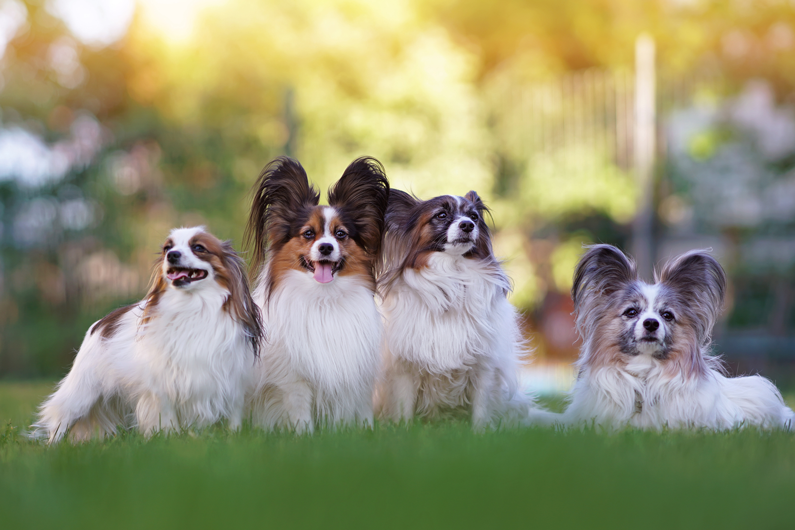
The overall appearance of a papillon is small, elegant, friendly, dainty, and lively. Their defining characteristic is butterfly-like ears. They are also defined by their silky, flowing coat and energetic nature that often keeps them going strong until age 15 or even longer.
To learn more about the physical characteristics of this breed, here is an overview of the breed standard information for papillons:
Head:
- Dark, round, and medium-sized, alert eyes
- Erect or drop-type ears with rounded tips
- Small head with medium width
- Muzzle abruptly thinner than the head and tapering to the nose
- Teeth meet in a scissors bite
Neck, Topline, Body:
- Medium length neck
- Straight and level topline
- Medium-depth chest with well-sprung ribs
- Long and high-set tail arched over the body
Forequarters:
- Well-developed shoulders arched over the body
- Slender, fine-boned, and straight forelegs
- Optional to remove dewclaws on forelegs
Hindquarters:
- Well-developed and well-angulated hindquarters.
- Slender hind legs parallel when viewed from behind.
- Dewclaws, if any, must be removed from hind legs.
Coat:
- Long, silky, flowing, and straight.
- Profuse frill on chest
- No undercoat.
- Long, flowing plume on tail
Color:
- Parti-color or white with patches
- Symmetry of facial markings
- No preference among colors other than nose, lips, and eye rims pigmented black
Gait:
- Quick, easy, free, and graceful gait
- No stiff hip movements
Caring for Papillons
Something good to know about papillons is that they are adaptable and heartier than they look. These dogs can thrive in both warm and cool weather, in city and country settings, and with families of varying types. Papillons make great apartment dogs (as long as they get out frequently for exercise), but they also love having a backyard to run around in. Families with kids should supervise interactions with papillons because they are small-boned and could be injured if a child plays too roughly with the dog.
Here are some general tips for taking the best care of a papillon:
Best Living Environments:
- Good apartment dogs but need an outlet for their energy
- Houses with fenced yards are excellent
- Monitor the behavior of these daring dogs so they don’t jump from high places and get injured
- Not suited for living outdoors full-time
Type of Exercise:
- Playtime in a yard or house
- Take on 30-minute walks at least twice per day
- Puppies do well with three 15-minute walks per day
Mental Enrichment:
- Agility training courses or other sports
- Provide safe spaces to play
- Toys and playtime with family members
- Likes to be active and playful more than be held and cuddled
Training Strategies:
- Keep on a regular schedule for housetraining
- Puppy-proof your house or crate the dog when you are not home
- Use positive reinforcement with food rewards and praise during training
Grooming Tips:
- Brush or comb coat once or twice per week
- Coat is not overly prone to matting
- Don’t shed much
- Only bathe occasionally due to minimal odor
- Trim nails as needed
- Brush teeth daily

Common Health Problems of Papillons
Papillons have excellent longevity and enjoy a life span of approximately 14 to 16 years. These are generally healthy dogs that are usually very active and not as prone to weight gain as some other dog breeds. However, papillons are genetically predisposed to certain health issues because of their breeding history. The Canine Health Information Center recommends that papillons be tested for heart disease, patellar luxation, eye diseases, and neuroaxonal dystrophy prior to breeding.
These are some of the most common health issues that arise with papillons:
- Patellar luxation (slipped kneecaps)
- Hypoglycemia (low blood sugar)
- Progressive retinal atrophy (a degenerative eye disorder)
- Collapsing trachea (breathing difficulty)
- Open fontanel (soft spot on the head)
- Pharyngeal gag reflex (reverse sneezing)
Diet and Nutrition for Papillons
Most adult papillons will thrive when eating a high-quality, nutritionally complete and balanced adult dog food. Puppies should eat puppy food until they are around nine months old. These small dogs need to eat more frequently than big dogs to prevent their blood sugar levels from dropping, particularly as puppies. Therefore, you may need to feed your papillon puppy five small meals per day and keep the meals about four hours apart to prevent hypoglycemia. Adults generally do well with two to three meals a day. If you feed your papillon homemade dog food, make sure you are working from a recipe that is designed by a veterinary nutritionist and that is appropriate for your dog’s age and health status.
Feed the amount of dog food needed to keep your pet slim. You should be able to see your papillon’s waist and feel (but not see) the ribs without having to press too hard. In general, puppies need more calories per day than do adults, but a dog’s needs will vary with their activity level and other factors. Don’t leave food out all day for a papillon to graze on.
Talk to your veterinarian if you have any questions about your papillon’s diet or health.

Where to Adopt or Purchase Papillons
The Papillon Club of America is a reputable resource for a breeder directory if you are looking to purchase a papillon puppy. You can search for local breeders by state in this directory.
If you prefer to adopt a rescue pup in need of a forever home, there are rescue groups and nonprofit organizations that specialize in this breed of dog. For example, there's Papillion Haven Rescue, Papillon 911 Rescue and Adoption, and Papillons and Playmates Rescue that may be able to connect you to your new, potential pet.
Related Breeds
If you like the idea of a small, charming, and smart dog, there are other similar and related dog breeds that you might want to also learn about before settling on a papillon as your new companion. Here are some other breeds for comparison:
- Russian toy
- Japanese chin
- Chihuahua
- Toy fox terrier
- English toy spaniel
- Shih Tzu
There are also popular papillon mixes that you can bring into your household, such as the chion (papillon + chihuahua, paperanian (papillon + Pomeranian), and pappipoo (papillon + poodle).
Pet Insurance for Papillons
Even for these healthy, long-living dogs, papillons are ideal candidates for pet insurance through Healthy Paws. These daring and confident dogs frequently get into accidents because they climb too high, jump too far, and put a dangerous level of strain on their fragile bones. Fortunately, Healthy Paws offers papillon health insurance for new accidents and injuries, plus breed-specific and hereditary conditions that may start to become symptomatic as your dog gets older.
With Healthy Paws, you can choose from flexible deductible and reimbursement options to tailor your monthly premium and make pet health insurance more affordable than ever before. Visit our quote page to see insurance rates, or call us at 855-898-8991 to speak to our customer service team and learn more about why dog insurance is so important for papillons.